
Advertisement

LIGO Scientists Settle Gravitational Wave Rumors

Gravitational waves detection marks a breakthrough in observational astronomy with LIGO confirming Einstein's prediction through a black hole collision.

Google NewsGoogle News Preferred Source

Newsletter

Sign up for our email newsletter for the latest science news

Sign Up

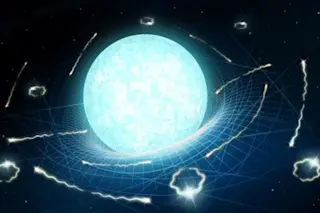
Laser Interferometer Gravitational-Wave Observatory, or LIGO, detected gravitational waves generated by a black hole collision. The event is seen in this still from a computer simulation. On Thursday, scientists confirmed yet another aspect of Albert Einstein's theory of gravity. Rumors were correct, and researchers at the Laser Interferometer Gravitational-Wave Observatory (LIGO) announced that they directly detected a gravitational wave, or a ripple in the fabric of space-time. LIGO’s twin detectors, in Louisiana and Washington state, use lasers to watch for these tiny stretches and squeezes of space-time. Einstein published his pioneering work predicting the existence of gravitational ripples a century ago. The timing of the LIGO breakthrough couldn't be better.

Advertisement

Scientists from Caltech, MIT and the LIGO Scientific Collaboration gathered to deliver the news about their detection efforts at 10:30 a.m. EST from the National Press Club in Washington, D.C. The finding represents one of the most significant scientific discoveries of the decade, and launches a new era in observational astronomy. Discover has the news covered from a variety of angles. Read the full story here:

Our free download explains all you need to know about gravitational waves — what they are, how they relate to Einstein’s theory of general relativity and how astronomers have researched these space-time wrinkles over many decades. Our gravitational waves hub page includes a series of articles that put LIGO's detection into perspective.

Stay Curious

JoinOur List

Sign up for our weekly science updates

View our Privacy Policy

SubscribeTo The Magazine

Save up to 40% off the cover price when you subscribe to Discover magazine.

Subscribe
Advertisement

1 Free Article