

Shooting across space to save the world, Project Hail Mary-style, to colonize distant planets, or simply to explore the cosmos is a common sci-fi fascination. But just how plausible is the idea that we could visit an exoplanet one day, and importantly, get there in good health?
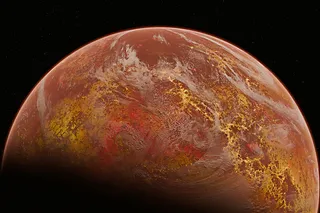
While Project Hail Mary’s Ryland Grace heads to Tau Ceti, a star system 11.9 light-years away, Proxima Centauri is the most likely candidate for humanity's first interstellar venture. By comparison, it is a mere 4.2 light-years from Earth. That system is also home to Proxima b, the closest exoplanet.
But getting there would prove challenging and long, to say the least.
How Long Would It Take to Get to Proxima Centauri
Project Hail Mary’s vessel used a supercharged, alien organism as fuel and arrived at its destination in about 12 years. Reaching Tau Ceti in the Apollo 10 module, which reached nearly 25,000 miles per hour (40,000 kilometers per hour), would take a whopping 320,000 years, Sara Webb, the course director at the Centre for Astrophysics and Supercomputing at Swinburne University of Technology, reported in The Conversation.
Traveling at the top speed reached by the 2006 New Horizons craft — roughly 9.94 miles per second (16 kilometers per second) – would require roughly 80,000 years to reach Proxima Centauri, Ashok Kumar, a retired astronomer previously with the Physical Research Laboratory, told Discover.

 Explore All Options
Even though technology has changed in the last 20 years, "if you use chemical fuel for the rocket, and you use the best possible things we know now, you will need 17,000 years of travel to reach Proxima Centauri,” said Kumar.
He takes a grim view of the potential journey.
“The fuel needed turns out to be equal to the mass of our galaxy […] which is, of course, ridiculous,” he said.
Read More: Interstellar Mission to a Black Hole Could Be Possible in 20 to 30 Years
Proposed Future Technology
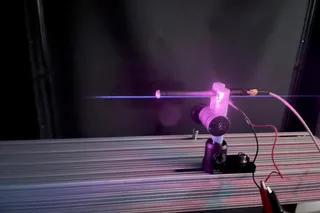
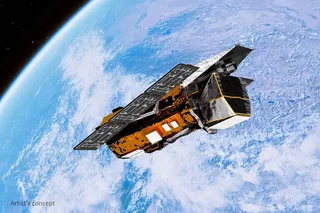
More optimistic scenarios, utilizing new technology, could, in theory, trim this down substantially. Without achieving the sci-fi Holy Grail of Faster-Than-Light travel, various propellants — chemical fuels, uranium, and antimatter — and novel propulsion methods like solar sails are up for proposal. NASA, meanwhile, is exploring sending a swarm of tiny probes pushed along by lasers to Proxima Centauri with around 20 years of “cruise” time. Those, of course, would be unmanned.
Others have explored different challenges posed by such a venture, like the not-insignificant task of ensuring human beings are alive and well when they arrive at their exoplanet destination.
One proposal is a so-called generation ship. Drawing on early ideas of “interstellar arks” described by Robert H. Goddard and the 1980s proposal of “World Ships,” these self-sustaining vessels would ferry hundreds or thousands of humans to a new world.
Last year, Project Hyperion gathered dozens of submissions for proposed interstellar ships. The winner, dubbed the Chrysalis, was a mammoth 36-mile-long vessel, complete with huge biomes that store Earth's biodiversity. Using hypothetical nuclear fusion reactors, it would take 2,400 people to Alpha Centauri in only 400 years.
“The most difficult, but also interesting and stimulating part, was thinking about how the humans aboard the starship would live and conceive their existence over multiple generations,” the Chrysalis team wrote in a statement.
Keeping a Crew Healthy During Long-Distance Missions
Beyond the travails of engine design, maintaining a healthy crew is complex.
“If you want to travel in the between stars for long periods, you will need to grow food. You will need to recycle oxygen. You will need to recycle gas, and you will need to produce things,” Frédéric Marin, an astrophysicist at the Astronomical Observatory of Strasbourg, told Discover.
That would include recreating gravity on board.
“Traveling in space is traveling long distance in a habitat which is extremely hostile,” Marin said. “I mean space doesn't want us there.”
That’s unless the ship is a sleeper, with individuals in extended hibernation or “cryosleep,” like in Project Hail Mary. On that front, researchers announced in a 2026 PNAS study that they successfully restored mouse brain tissue subjected to deep freezing. Such a prospect, however, remains far off.
The Ethical Implications of Going to an Exoplanet
Marin and his team calculated that a generation ship needs at least 100 people. That’s based on steady reproduction. But it opens up another discussion entirely: whether such a venture is ethical. As astrophysicist Camille Marin told Discover, their study, through the HERITAGE project, is purely mathematical and doesn’t account for the ethics of such an endeavor.
Inhabitants of such a vessel would face incredible restrictions for a prolonged period, and maintaining a crew of 100 is predicated on women on board having children regularly with select crew members to maintain genetic diversity.
“To impose that on the population is a totally different thing,” she said.
They believe that ultimately and despite the numerous challenges, a major barrier to building such a ship would come down to the eye-watering costs that would run into the trillions of dollars.
For Kumar, the extreme fuel requirements alone rule out interstellar space travel for the foreseeable future.
“I think it will remain in science fiction,” he said.
Marin, however, takes a different view: what may seem a daunting, nigh-on impossible venture now could change as technology continues to develop. The possibility of a moon base and a potentially budding space industry in the near future opens doors, so within a few hundred years, the outlook for exoplanet travel may be more favorable.
“The idea of space travel becomes less than science fiction, but more like a project to work on with better tools,” he said.
Read More: 6 Exoplanets in our Universe That Could Support Life Other Than Earth
Article Sources
Our writers at Discovermagazine.com use peer-reviewed studies and high-quality sources for our articles, and our editors review for scientific accuracy and editorial standards. Review the sources used below for this article:
- This article references information from The Conversation: Project Hail Mary is packed with hard science. An astrophysicist breaks it down
- This article references information from NASA: Swarming Proxima Centauri: Coherent Picospacecraft Swarms Over Interstellar Distances
- This article references information from the British Interplanetary Society: The BIS Lunar Spaceship
- This article references information from the Initiative for Interstellar Studies: World Ships Feasibility and Rationale
- This article references information from Project Hyperion
- This article references information from Project Hyperion: Chrysalis
- This article references information from a study published in PNAS: Functional recovery of the adult murine hippocampus after cryopreservation by vitrification
- This article references information from the HERITAGE Project: Cryo-Sleep in Space Exploration: A Viable Solution for Long-Term Space Travel