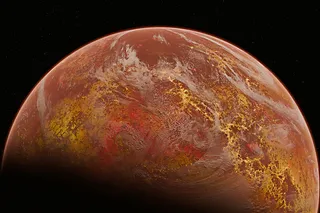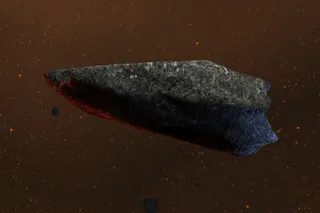


The small clique of dwarf planets in our solar system may soon be joined by a newcomer after an astounding discovery from the Vera C. Rubin Observatory. Looking past Pluto, the observatory caught sight of a rare object that had evaded detection by other telescopes. Astronomers have now identified the icy object, called 2026 ED138, as a new dwarf planet candidate.
ED138 is no normal candidate, either. It may be one of the largest and brightest objects discovered beyond the orbit of Pluto. Further observations are needed to confirm the distance and brightness of ED138, but if it does indeed fit the criteria of a dwarf planet, it would promptly be added to the ranks of the solar system’s five existing dwarf planets: Pluto, Ceres, Eris, Haumea, and Makemake.
“Finding an object this big, roughly 1,000 kilometers [621 miles] across, is something that happens maybe once in a generation,” said Mario Jurić, a professor at the University of Washington and leader of Rubin’s solar system team, in a statement.
Chancing Upon a Dwarf Planet Candidate
Finding ED138 was something of an unexpected moment for Matthew Holman, an astrophysicist at the Harvard & Smithsonian Center for Astrophysics who works to improve Rubin’s algorithms that search for distant moving objects in the solar system.

 Explore All Options
On October 13, 2026, Holman was running data collected by Rubin earlier in 2026 through a search code that he co-developed to gather billions of detections of moving objects, compare them, and target detections that correspond to the same object. It was through this search code that Holman noticed ED138, which seemed to be unusually large due to its estimated brightness and distance.
“My first reaction was one of excited disbelief,” said Holman. “Objects like this are very rare, so I immediately started checking whether I or the code had done something wrong.”
After Holman spotted ED138 through the search code, Jurić went back through Rubin’s catalogs and uncovered 20 more observations of the object, going back to March 2026; It even appeared in archival images going back to 2016.
Meeting the Right Criteria
The research team found that ED138 — which is a trans-Neptunian object (TNO), signifying that it orbits the sun at a distance greater than Neptune’s orbit — is currently at a distance of 46 astronomical units (au), while Pluto orbits at an average distance of 40 au. For context, 1 au is the average distance between Earth and the sun.
TNOs often provide clues on how the solar system formed and how giant planets moved over time, but not all of these objects are considered dwarf planet candidates.
To be a dwarf planet, an object must fit two criteria set by the International Astronomical Union in August 2006: It has to orbit the sun, and it must have enough mass that it has formed into an approximately round shape under its own gravity, according to the European Space Agency. To become a planet (as opposed to just a dwarf planet), an object must also have a strong enough gravitational pull to clear its neighborhood of any other celestial objects of significant mass (except for its own satellites, like moons).
The distance, brightness, and estimated surface reflectivity of ED138 have led the research team to estimate the object’s size at somewhere between 600 and 1,500 kilometers (or between 372 and 932 miles). This would likely give it that round shape necessary to be considered a dwarf planet.
“It’s the largest trans-Neptunian object found in about 20 years, and Rubin turned it up while we were still commissioning the telescope,” said Jurić.
A Rare Find for Rubin
ED138 lies in a region of the sky close to the plane of the Milky Way. Here, millions of stars have obscured ED138, but Rubin's continuous monitoring of the entire Southern Hemisphere sky helped astronomers to single out the dwarf planet candidate.
Over the next 10 years, Rubin is expected to detect myriad objects that, like ED138, haven't been noticed in previous observations. And while astronomers will still need to observe ED138 in infrared light to confirm its true size, it could soon become the solar system's sixth recognized dwarf planet if it measures up.
Article Sources
Our writers at Discovermagazine.com use peer-reviewed studies and high-quality sources for our articles, and our editors review for scientific accuracy and editorial standards. Review the sources used below for this article:
- This article references information from the ESA: Dwarf Planet
- This article references information from the University of Washington: Rubin Observatory reveals its first dwarf planet candidate in our solar system