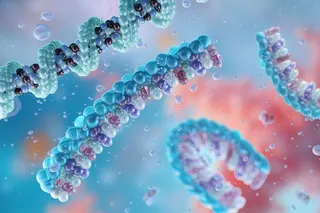


When cells in our body are going through a rough patch due to radiation or botched attempts to divide, they sometimes link up with other cells to safely hand over their DNA. This process of DNA transfer — supported by tiny tubes that form between two cells, passing DNA from one to the other — has been observed for the first time in human cells, and this discovery may very well change how we think about our cells.
A new study published in Cell found that human cells are capable of responding to genomic instability by relocating pieces of DNA to other nearby cells. When this happens, two cells connect by way of nanotubes that act like chutes, delivering DNA that remains active. Researchers are now looking into how this transfer mechanism plays a role in human health, especially cancer development.
“I think our study was important because it was the first to demonstrate proof of principle that large pieces of DNA — half of a chromosome, maybe even more of a chromosome — could shuttle between cells,” said Peter Ly, an assistant professor at Children’s Medical Center Research Institute at UT Southwestern, in an interview with Discover.
DNA Transfer Between Human Cells
Normally, when it comes to our own cells, we think about gene transfer in a “vertical” sense — that is, genes are passed down from a parent cell to daughter cells, offspring that are born through cell division.

 Explore All Options
However, there is such a thing as “horizontal gene transfer,” when genes are shared between organisms that don’t have a parent-offspring relationship. This is most prevalent in prokaryotic microorganisms (those in the domains bacteria and archaea), but it also plays a role in plants and insects. Evidence of horizontal gene transfer in humans and other mammals, meanwhile, has been limited.
The new study, however, shows that there is a process akin to horizontal gene transfer in human cells. Researchers noticed this process while testing to see how cells respond to genomic instability; genome instability, according to a 2015 Carcinogenesis study, occurs when various processes involved in maintaining and replicating the genome are dysfunctional. It can be caused by several factors, including chemicals, biological agents, radiation, and errors in mitosis (cell division).
A New Home for DNA
To observe DNA transfer in action, the researchers used advanced live-cell microscopy, allowing them to see how cells formed nanotube connections. In one experiment, they watched as fragments of the Y chromosome from male cells moved to female cells; the transferred DNA remained functional, with male-specific genes activating even after the DNA entered the female cells.
After being passed to a new cell, transferred DNA was shown to persist after multiple rounds of cell division, and even bestow new phenotypic traits to recipient cells; for example, genes associated with drug resistance can cause recipient cells to become resistant to certain antibiotics once they are transferred.
“I think the other exciting part is that when the DNA transfers to the other cell, it’s not just nonfunctional debris; it actually can go into the nucleus of that cell and then become a part of its genome. And when that cell then replicates itself and divides into two cells, now you have two cells that have that DNA change, and this can then become heritable over many generations,” Ly told Discover.
Read More: Disrupting DNA Repair May Help Defeat Drug-Resistant Cancer
Transforming Cancer Research
The authors of the new study write that this exchange of genetic material may have a profound impact on human biology. Having a better understanding of the mechanism behind the transfer could contribute greatly to cancer research, as it may enable cancerous cells to spread harmful genetic material to non-cancerous cells, including alleles related to tumor formation or mutations that increase susceptibility to cancer.
“There are many open questions. We now want to understand how widespread this process is, how it is regulated at the cellular and molecular levels, and what role it may play in human health and disease, including cancer,” Ly said in a statement. “These findings may have important implications for understanding how cancer genomes evolve and acquire large-scale chromosomal alterations.”
This article is not offering medical advice and should be used for informational purposes only.
Read More: Imaging Technique Reveals DNA’s Hidden Shape in the Earliest of Embryos
Article Sources
Our writers at Discovermagazine.com use peer-reviewed studies and high-quality sources for our articles, and our editors review for scientific accuracy and editorial standards. Review the sources used below for this article:
- This article references information from a study published in Cell: Genome instability triggers intercellular DNA transfer between human cells
- This article references information from a study published in Carcinogenesis: Causes of genome instability: the effect of low dose chemical exposures in modern society