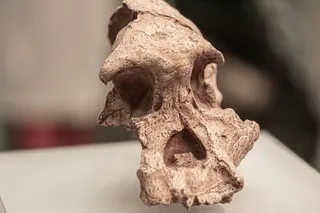


Early humans and neanderthals deployed complex hunting tactics to bring down big game. Homo sapiens’ diminutive cousins, Homo floresiensis, used a rather different tactic.
New research suggests the hobbit-like hominins were scavengers who picked over the food left by Komodo dragons. The research, published in Science Advances, contradicts previous theories, which assumed H. floresiensis displayed unexpectedly sophisticated behaviors, such as fire use.
Changing Our Understanding of H. floresiensis
Researchers have found H. floresiensis bones alongside stone artifacts and the remains of proboscideans, a group of animals that includes elephants and their extinct relatives. This has been used as evidence to demonstrate their hunting prowess and surprising ability to take down big game, despite their small stature and modest brain size. But it may be a red herring.
A re-examination of fossils at the Liang Bua site on the island of Flores, Indonesia, casts doubt on H. floresiensis’ reputation. The team examined the remains of a dwarfed species of proboscidean, Stegodon florensis insularis, and marks on the bone previously thought to be the work of H. floresiensis. In total, the researchers analyzed 3,155 bone fragments (equivalent to 27 percent of the assemblage), ranging in age from 190,000 to 50,000 years.
Read More: The Early Human Hobbit Vanished 61,000 Years Ago — And Climate Change May Be to Blame

 Explore All Options
Was H. floresiensis a Hunter or a Scavenger?
One of the only competitors H. floresiensis would have faced on the island of Flores was the Komodo dragon (Varanus komodoensis), the largest living reptile on the planet.
Komodo dragons have distinctive blade-like teeth, not dissimilar to those of theropod dinosaurs, which create complex patterns on the bones of their prey, according to a study in Nature Ecology & Evolution. To determine exactly what kind of mark these would have left on a fossil, the team conducted a controlled feeding experiment at Zoo Atlanta. This involved feeding an adult goat carcass to a captive Komodo dragon. The results show that teeth marks are “shallower, shorter, and have a wider profile angle” than the cut marks left by H. floresiensis.
This enabled the researchers to compare marks left on the Stegodon bones and determine the frequency and location of those left by both Komodo dragons and H. floresiensis. Of 154 marks, 100 were Komodo dragon teeth marks, and 54 were H. floresiensis cut marks.
Crucially, the positioning of these marks suggests the Komodo dragons had first dibs. Teeth marks were found on areas of the body with more meat, such as the forequarter and hindquarter, whereas cut marks were seen on less prime areas, such as the head and the feet. This suggests H. floresiensis engaged in passive scavenging, feeding on the Komodo dragons’ leftovers.
Did H. floresiensis Use Fire?
The research also puts a damper on the idea that H. floresiensis was able to exploit fire. Of all the Stegodon remains, only one showed signs of burning –– and its location near younger sediments suggests H. sapiens, not H. floresiensis, may have been responsible.
This was supported by analysis of 6,906 rodent remains. Roughly a third were found in layers linked to H. sapiens activity, of which approximately 20 percent showed evidence of burning and fire use. In contrast, two-thirds were found in layers associated with H. floresiensis, of which precisely zero showed signs of burning.
The results suggest that H. floresiensis was not as advanced as originally thought and provided a critical view into the behavioral repertoire of H. floresiensis, according to the study authors.
An Evolving Picture
This new evidence paints a picture of a less advanced hominid that survived on raw leftovers, rather than a hunter of large game. It also raises questions over its ancestry.
“H. floresiensis was initially described as “capable of complex behavior and cognition” in part because this species may represent an isolated island-dwarfed descendant lineage of H. erectus,” the study’s authors explain.
Instead, “The evidence to date thus suggests that H. floresiensis did not engage in a behavioral repertoire as diverse or as flexible as in modern humans or Neanderthals, possibly due to an ancestry in which large game hunting and controlled use of fire did not evolve.”
Read More: Hominins Moved Into the Neighborhood of the Hobbit Humans Around 1.04 Million Years Ago
Article Sources
Our writers at Discovermagazine.com use peer-reviewed studies and high-quality sources for our articles, and our editors review for scientific accuracy and editorial standards. Review the sources used below for this article:
- This article references information from a study published in Science Advances: Taphonomic analysis at Liang Bua reveals the behavioral and technological capabilities of Homo floresiensis
- This article references information from a study published in Nature Ecology & Evolution: Iron-coated Komodo dragon teeth and the complex dental enamel of carnivorous reptiles