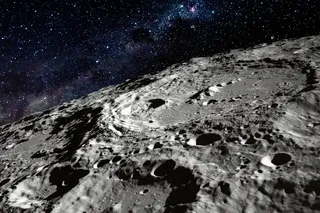


During the 60s and early 70s, astronauts on the Apollo missions brought back over 800 pounds of rock and soil from the moon’s surface, according to the Smithsonian National Air and Space Museum.
These lunar souvenirs offered a wealth of previously unavailable scientific data that has since improved our understanding of Earth’s satellite and the wider Solar System — but they also raised new questions.
One conundrum they raised is a question about the moon’s magnetism. The magnetized rock provided the first evidence that the moon once possessed a magnetic field. However, the nature of this magnetic field remains hotly contested.
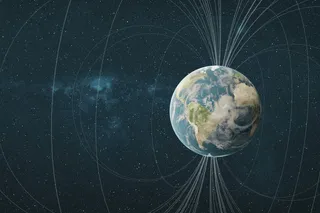
One theory is that the moon’s magnetic field was similar to our own, driven by the conversion of mechanical motion into electrical and magnetic energy. An alternative theory is that impacts from large meteorites and asteroids triggered the moon's magnetization.
Now, new research based on gravity and magnetic observations has been published in Science Advances, and it comes out in support of the former.
Read More: Terrestrial Particles Travel to the Moon by Hitchhiking Along Earth’s Magnetic Field Lines
Investigating The Dewar Magnetic Anomaly
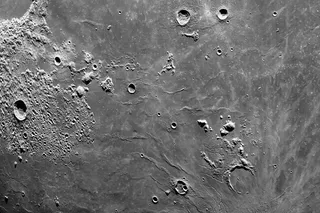
The Dewar swirl sits next to the Dewar crater and is found on the far side of the moon. Like many lunar swirls, it’s a bright pattern that stands in stark contrast to its surroundings, and it signals a magnetic anomaly. According to the researchers, this particular swirl contains some of the densest, most strongly magnetized rock on the moon’s surface.

 Explore All Options
“The Dewar region is a genuine stroke of luck: one of the strongest magnetic field anomalies on the far side of the moon and a distinct gravity anomaly coincide spatially there,” Anna Mittelholz, a geophysicist and lecturer at the Department of Earth and Planetary Sciences at ETH Zurich, Switzerland, said in a statement.
This combination of anomalies enabled Mittelholz and colleagues to calculate the density of material below the surface and, in turn, identify the material itself. Xi Yang, a Ph.D. student in the Department of Earth and Planetary Sciences at ETH Zurich, described the region as “a potential window into the moon’s internal structure.”
Unearthing a Buried Volcano
The team’s findings suggest the Dewar swirl sits atop a mass of rock that is 37 miles (60 kilometers) wide and 6 miles (9 kilometers) deep. It is thought to be a buried volcanic complex comprised of solidified magma that formed some 4.2 billion years ago.
“Because we know how much iron is present in such a rock body, we can estimate the minimum strength the magnetic field must have had as the magma cooled slowly,” said Mittelholz.
The results suggest a minimum strength of 11.4 microteslas, though it could be much higher.
A Core Dynamo
Because of its location, magnetism at the Dewar swirl is unlikely to have been caused by an impact. Therefore, the team concludes the magnetism was caused by geodynamic forces, similar to Earth’s, whose magnetic field is produced by the movement of molten iron in the outer core. Still, many questions remain, including how such a large magnetic field was able to form in a comparatively small core.
“But we are examining the question from an entirely new perspective,” said Mittelholz. “And so the question has shifted from “Was there a dynamo?” to “How did it work?”
Claire Nichols, Associate Professor of the Geology of Planetary Processes at the University of Oxford, told Discover the research lends more weight to the theory that the moon was able to produce an intense dynamo early in its history. Nichols, who was not involved in the study, added the results could be consistent with research her team published earlier this year in Nature Geoscience, which found evidence of rare but intense magnetism events lasting less than 5,000 years.
“Overall, I think this adds further motivation to keep adding to our observations during upcoming missions such as Artemis and Chang’e — there’s still a lot of open questions about the moon we are yet to figure out!”
Read More: Apollo Rocks Reveal The Moon’s Magnetic Field Was Both Strong and Weak
Article Sources
Our writers at Discovermagazine.com use peer-reviewed studies and high-quality sources for our articles, and our editors review for scientific accuracy and editorial standards. Review the sources used below for this article:
- This article references information from a study published in Science Advances: Magmatic origin of the Dewar magnetic anomaly: Implications for an early lunar dynamo
- This article references information from a study published in Nature Geoscience: An intermittent dynamo linked to high-titanium volcanism on the Moon
- This article references information from a study published in the Smithsonian National Air and Space Museum: Lunar Rocks