

For over ten years, residents in Austin’s Colony, a neighborhood in the Texas capital, have turned on their faucets not knowing whether the water would run clear or discolored.
Now, thanks to research published in PLOS Water, the community has an answer. Analyses reveal that several samples exceeded state and federal regulatory standards for contaminants, including lead and arsenic.
“With this paper finally coming out, one that’s academic and peer-reviewed, we finally have something that carries some weight,” Bianca Guerrero, a resident and community organizer, said in a statement.
“Our words and what we’re going through should carry weight, but we’re not going to get anywhere unless we have something that’s based on science.”
Read More: Brewing Tea Lifts Lead and Other Heavy Metals from Water
Analyzing water samples
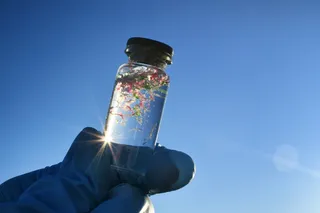
In a project described as a collaboration between the university, the community organization PODER, and residents, researchers analyzed 81 samples (78 clear; 3 discolored) collected in 2024 and 2025, the majority of which came from eight households.
Three of those samples contained levels of lead higher than the Texas standard (15 parts per billion, or ppb). One was almost twice as high (27.3 ppb).
The researchers also discovered arsenic and other contaminants, such as iron and copper, at levels exceeding the regulatory limits set by the Environmental Protection Agency (EPA) and the Texas Commission on Environmental Quality (TCEQ). In one sample, experts detected the toxic metal manganese at concentrations of 2,460 ppb, which is almost 50 times the EPA and TCEQ standard (50 ppb).

 Explore All Options
A survey was conducted alongside the bacterial and chemical analyses. Responses were collected from a hundred households, 70 percent of whom reported experiencing discolored water at some point. Of those, almost a quarter (24 percent) reported experiencing discolored water for days at a time.
Responses showed that the frequency of discolored water varied by household, with 37 percent reporting it occurred yearly, 46 percent monthly, and 6 percent weekly.
Finding the Contaminant Source in Austin
Digging a little deeper, the researchers discovered the likely reason for the metal contamination, linking the discolored water to a section in the neighborhood plumbing system where water from different sources mixes.
The 8,000 or so residents of Austin’s Colony receive water from three separate water sources — wells in Austin’s Colony, wells in Manor, and the Carrizo-Wilcox Aquifer. The team’s findings show that water at the sources met regulatory standards, as did water entering the neighborhood. It was only when the water reached the local water system and mixed with water from other sources that contamination occurred.
The researchers attribute the discoloration to contaminant buildup and erosion, which may be driven or exacerbated by mixing different water sources and the resulting “water turbulence,” according to the study.
Household water treatment systems appeared to be effective at removing contaminants and minerals that made the water hard. Seventy-one percent of survey respondents reported having a water treatment system, but as the study’s authors note, these can be expensive, and not everyone has access.
The Issue Goes Beyond The Neighborhood
This is not just a local issue. The researchers emphasize that as water scarcity rises, many suppliers respond by mixing water from different sources, increasing the likelihood of water quality issues.
As for the residents of Austin’s Colony, they now have the evidence needed to move things forward and seek policy changes.
“The community can now take that research and move to the next step, whether that’s looking at legislation, looking at policy,” Susana Almaza, the director of PODER, said in a statement. “We have something that we can take on and move forward.”
Read More: Orange Rivers in Alaska Signify a Color-Changing Crisis, Exposing Fish to Toxic Metals
Article Sources
Our writers at Discovermagazine.com use peer-reviewed studies and high-quality sources for our articles, and our editors review for scientific accuracy and editorial standards. Review the sources used below for this article:
- This article references information from a new study published in PLOS Water: Identifying impacts and causes of drinking water quality issues through community-based participatory research in a suburban neighborhood in Texas: The case of Austin’s Colony