Despite its prevalence on Earth, volcanism is not particularly common in our solar system. Although some distant moons show varying degrees of current volcanic activity, many of the other rocky planets that circle our sun appear dormant. But new research suggests that some of our closest neighbors may be more geologically active than previously thought. Recent discoveries, including evidence of marsquakes, are adding weight to theories that Mars could still be volcanically active.
Now, a team from the Space Research Institute of the Russian Academy of Sciences (IKI) has identified traces of hydrogen chloride (HCl), a noxious gas associated with volcanic activity in the Martian atmosphere. As described in their study published in Science Advances, this discovery, combined with other recent findings, offers new evidence about the planet’s geological activity.
Read More: Hidden Lunar Volcano Suggests the Moon Once Had an Earth-Like Magnetic Field
Gases Associated with Active Eruptions Detected on Mars
Scientists have long searched for signs of volcanic activity on Mars, but detecting it isn’t necessarily straightforward. While gases such as sulfur dioxide can indicate ongoing eruptions, researchers can also look for other gases released by magma beneath the surface. One example is hydrogen chloride, which can escape into the atmosphere through volcanic outgassing.
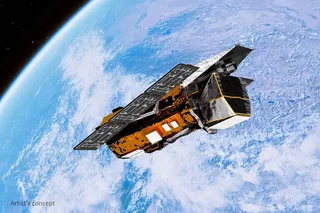
Using data collected by the Atmospheric Chemistry Suite, which consists of three infrared spectrometers to map minor atmospheric changes on Mars, aboard the ExoMars Trace Gas Orbiter (TGO), the IKI team has detected HCl at parts-per-billion concentrations in the Martian atmosphere.

 Explore All Options
Interestingly, these unusually high levels appeared during the planet’s cold aphelion season, which corresponds to the spring and summer of the Martian Northern Hemisphere, as explained by Icarus. The detections were located above the Alba Mons region, an area where relatively fresh surface fissures were discovered.
Hints of Seismic Activity on Mars
For decades, planetary scientists have debated whether Mars is still volcanically active. Although the planet lacks the shifting tectonic plates that drive much of Earth’s geological activity, it is far from completely quiet. Scientists have detected marsquakes, offering insights into the planet’s still active interior.
A 2025 study published in Science examined seismic waves recorded by NASA’s Insight lander and found that some high-frequency waves arrived later than expected. The delay increased with the distance the waves traveled through Mars’ mantle, suggesting that its interior is unusually heterogeneous, or unevenly mixed.
Researchers believe this jumbled structure may be a remnant of the planet’s early history, shaped by massive collisions and irregular movements of material deep underground.
Gas May Originate from Active Magma, Seeping Through Fresh Fissures
The team notes that the HCl detections appeared above newly identified surface fissures that the researchers suspect could extend deep enough to reach active magma. This could provide a pathway for volcanic gases to escape into the atmosphere.
“Detections of HCl at low altitudes, unexplained by observed atmospheric state and models, together with the geological context of the region, hint at an igneous origin of this gas,” the authors wrote in their paper.
The researchers suggest that continued observations by the TGO, particularly over the Tharsis and Cerberus regions, could reveal more localized HCl emissions. However, the gas doesn’t necessarily linger in the atmosphere. Its concentrations may fluctuate depending on volcanic activity, atmospheric processes, and how much gets trapped in surface salts and ice.
While more observations are needed to confirm the source of these emissions, the findings offer another intriguing hint that Mars may not be as geologically dormant as we once thought.
Read More: Mars’ Mantle Is Like Rocky Road Ice Cream and Offers a Glimpse to Its Ancient Past
Article Sources
Our writers at Discovermagazine.com use peer-reviewed studies and high-quality sources for our articles, and our editors review for scientific accuracy and editorial standards. Review the sources used below for this article:
- This article references information from a study published in Science Advances: Enigmatic HCl detections as a potential signature of igneous activity on Mars
- This article references information from a study published in Icarus: Water Vapor Saturation at Low Altitudes around Mars Aphelion: A Key to Mars Climate?
- This article references information from a study published in Science: Seismic evidence for a highly heterogeneous martian mantle