

Fossils of a saber-toothed cat that roamed North America more than 5 million years ago are helping to fill in the incomplete history of the ancient world's fearsome felid predators. A nearly complete skull of an enigmatic saber-toothed species, Adelphailurus kansensis, turned up in an unexpected location: a museum drawer.
A new study published in the Journal of Vertebrate Paleontology has identified the cranium, teeth, and lower jaw that were fortuitously dug out of a drawer at the American Museum of Natural History, confirming that the fossils belong to A. kansensis. Among the most notable qualities of this cat were its serrated knife-like teeth, which were perfect for shredding flesh — these sharp teeth, though, may have eventually played a role in the decline of saber-toothed cats.
Read More: How a Fossil Hotspot Reveals Two New Species of Sabretooth Cat
Identifying a Saber-Toothed Cat Cranium
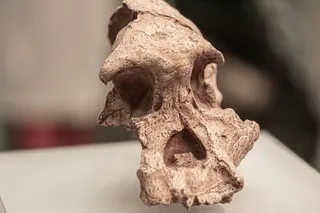
When University of California, Berkeley postdoctoral fellow Narimane Chatar pulled a peculiar felid cranium out of a drawer at the American Museum, she knew she had stumbled upon something surprising. The cranium, originally from Arizona, was labeled Pseudaelurus (meaning “false cat”), a catch-all designation for any unidentified fossil that looks like a cat.

A scan of the fossil cranium of Adelphailurus kansensis
(Image Credit: Narimane Chatar, J. Gamarra, AMNH)
This cranium, however, didn’t look like any modern cat. Chatar scanned the fossil and would later compare it to the original fossil of A. kansensis, which was discovered in Kansas in 1924. The two fossils shared many similarities, leading Chatar to determine that the American Museum cranium was actually another set of remains from A. kansensis.

 Explore All Options
Chatar compared this first complete skull of A. kansensis with other saber-toothed cats, including the poster child of the felid predators, Smilodon, which lived in the Americas from roughly 2.5 million to about 10,000 years ago.
“Back in the days when we thought about sabertooths, we thought ‘Smilodon,’ and that's it. We thought that all species that exhibited a somewhat saber-like tooth morphology must have hunted like Smilodon and behaved like Smilodon,” Chatar said in a statement. “We are now starting to see a great disparity within those animals, and especially in the early diverging taxa, like Adelphailurus kansensis.”
The Problem With Larger Teeth
Saber-toothed cats, naturally, are known for their sharp teeth. But these cats didn’t always have the exact same teeth from their emergence to extinction. Saber-toothed cats had upper canines that were flattened laterally, like a knife, allowing them to effortlessly slice flesh and sever arteries. These teeth eventually evolved to become larger; the slightly serrated teeth of the early-diverging A. kansensis were smaller than those of the late-diverging Smilodon.
But larger teeth weren’t necessarily a ticket to survival, as saber-toothed cats’ teeth were much more fragile than those of modern cats. Simulations in the new study showed that large, 3D-printed Smilodon teeth were the best at penetrating through a gel with the consistency of flesh, but were also the most likely to fracture against bone.
Essentially, saber-toothed cats developed larger, sharp teeth that were great at killing certain kinds of prey like camels and bison, but they couldn’t get rid of these teeth when said prey started to die out after the last ice age. They were subsequently outcompeted by carnivores with rounder, sturdier teeth, such as molars that could crunch bones without breaking them.
“We've never found any lineage that started developing long upper canines and then stopped and went back to a less specialized state; once a group starts, they (the fangs) go crazy, and then they go extinct,” Chatar said.
Hidden Finds in Museum Drawers
A. kansensis ultimately represents a stage in saber-toothed cat evolution when these predators hadn’t yet grown large teeth. But a few million years later, Smilodon fatalis, California’s state fossil and the last surviving saber-toothed animal, would end up with upper canines that were around 7 inches long. At this point, though, their large teeth might’ve only hastened their downfall.
According to Chatar, less is known about early-diverging saber-toothed species (like A. kansensis) compared to late-diverging species (like Smilodon). However, the new study shows that more details on early species like A. kansensis may come to light as museum collections are reexamined.
“It highlights the need to go back to those old collections and open every single drawer and look at those specimens, because there might be amazing fossils like this one just hidden somewhere, labeled cat or Pseudaelurus or something else, that just need to be described,” Chatar said.
Read More: Everything You Need to Know About the Saber-Tooth Tiger Extinction
Article Sources
Our writers at Discovermagazine.com use peer-reviewed studies and high-quality sources for our articles, and our editors review for scientific accuracy and editorial standards. Review the sources used below for this article:
- This article references information from a study published in Vertebrate Paleontology: New material of Adelphailurus kansensis sheds light on the cranial anatomy of an early-diverging machairodontine felid