


David DeMar Jr. was searching for fish fossils in northeastern Montana when he found something he hadn’t expected in a small, reddish-brown lump. He had been crawling up a rocky outcrop when he collected it, then brought out his hand lens for a closer look. On the surface, he could make out a tiny feather.
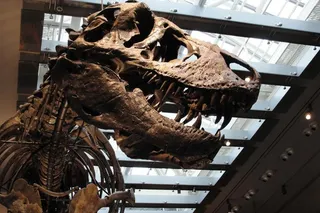
The specimen, which he collected in 2016, turned out to be fossilized poop containing feathers and bones from a bird eaten about 66 million years ago, possibly by a T. rex or Nanotyrannus. Inside, researchers would find feathers preserved in 3D, with details they could compare to those of living birds.
“I was cautiously optimistic about its discovery, because feathers had not yet been found in the Hell Creek Formation, even after more than 150 years of prospecting," DeMar, a research scientist at the University of Washington’s Burke Museum, said in a press release.
The dinosaurs that would eventually become birds were the only ones to survive the asteroid-driven mass extinction 66 million years ago, and even among them, only one branch of the family survived. That lineage gave rise to every bird alive today. The new study, published in Current Biology, explores whether differences in how well feathers kept birds warm helped determine which groups survived the cold conditions after the impact.

 Explore All Options
Dinosaur Poop Preserved Ancient Bird Feathers

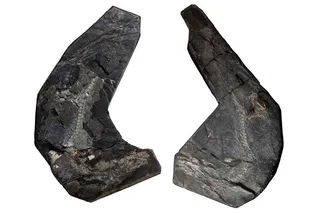
Exposed fossil feather in the coprolite fragment.
(Image Credit: David DeMar, Jr.)
Paleontologist Nate Carroll had studied feathers trapped in amber from Myanmar for his thesis. Yet the feather in this ordinary-looking lump was better preserved than many of those specimens.
He suspected the lump was a coprolite, the scientific term for fossilized poop. The team analyzed its mineral makeup and used a micro-CT scanner to look at what was inside.
“Every hour processing the data revealed another feather, another scale, another bone — in stunning 3D,” Carroll said in the press release.
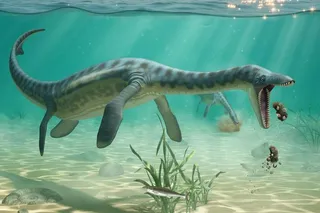
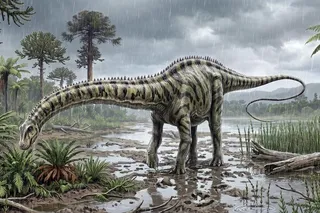
For Carroll, finding such well-preserved feathers in fossilized poop from his home state of Montana was especially exciting. Alongside several feathers were gar fish scales and leg bones from an extinct diving bird called a hesperornithiform, the likely source of the feathers.
How Feathers May Have Helped Birds Survive

Close-up of the feather
(Image Credit: O’Connor et al)
Lead author Jingmai O’Connor has spent years studying why the ancestors of living birds survived the mass extinction while other birds died out. Some researchers have proposed that living near water helped protect the survivors from the effects of the asteroid impact.
But hesperornithiforms also lived around water, and their entire group went extinct. Most could not fly and instead used their feet to dive for food, much as loons do today. Their extinction means an aquatic habitat alone cannot explain why some birds survived.
O’Connor wanted to know whether their feathers could help explain why. The fossil gave researchers their first opportunity to examine feathers from this group.
“Some of these diving birds’ feathers seem to have been modern-looking and waterproof, but they also had some smaller, fuzzy, primitive body feathers that we associate with dinosaurs and enantiornithines,” said O’Connor in the press release.
Those smaller feathers may have provided less insulation than the body feathers of the ancestors of living birds. Similar feather types were also present in enantiornithines, another group of birds that died out.
After the asteroid impact, cold conditions during the winter would have made staying warm a challenge, and therefore, birds with feathers that held in more body heat may have been better equipped to survive.
Looking Again at Fossilized Droppings
O’Connor often studies fossils with whole skeletons preserved. Here, she had to work from the pieces left behind after a meal.
“It made me feel like a detective, piecing together all these little clues,” said O’Connor.
She hopes more researchers will scan coprolites for feathers. DeMar’s find depended on a detail that made an otherwise unremarkable lump worth examining.
“We only knew to look at this one because of how it happened to be split open, with the feather exposed — it was literally a lucky break,” O’Connor concluded in the press release.
Read More: Rare Fossilized Teeth Fill a Major Gap in Early Mammal Evolution After the Dinosaur Extinction
Article Sources
Our writers at Discovermagazine.com use peer-reviewed studies and high-quality sources for our articles, and our editors review for scientific accuracy and editorial standards. Review the sources used below for this article:
- This article references information from a study published in Current Biology: Bird feathers from a Late Cretaceous coprolite