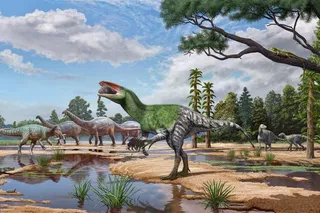
Crocodiles have a reputation as a “living fossil” — a species that’s existed, basically unchanged, for eons. And while the term isn’t quite accurate, it’s easy to see why it’s stuck. The crocodilian lineage first appeared around 250 million years ago, long before dinosaurian headline acts like Stegosaurus and Triceratops.
The lineage survived multiple mass extinctions, including two of Earth’s largest; endured wild fluctuations in planetary climate and geology; and outlived the dinosaurs, thriving with the rise of mammals.
They are, it seems, hard to kill off. But why? A new study, published in the journal Science Advances, has a hypothesis — and it all comes down to the animals’ preference for warmer climes.
Crocs Like It Hot
“[Crocodiles’] ancestors and relatives changed enormously throughout their history, ranging from giants the size of a bus that could have devoured a T. rex, to small, cute animals with the face of a pug,” said Alfio Alessandro Chiarenza, a paleontologist based at University College London’s Department of Earth Sciences and lead author of the study, in a press release.
But, he explained, “despite all this diversity, what stayed surprisingly consistent was their relationship with climate.”
Put simply, crocodiles like it warm — so much so, in fact, that they’d rather move with a changing climate than adapt to a new one. While other species may have reacted to the dramatically cooling environment of, say, the Eocene-Oligocene transition of 34 million years ago by developing larger, hardier jaws, bigger bodies, and generally more diverse morphologies than before, the crocs simply retreated, finding any remaining pockets of tropical heat in which to wait out the cold.

 Explore All Options
This happened again and again. From the Jurassic period onwards, ancient crocodiles, known to scientists as the pseudosuchians, spread out polewards during warmer phases of the Earth’s history — only to migrate back to the equator when things got cooler.
So tied were the crocs to their favorite climate classification that the team found just two occasions, across close to a quarter of a billion years of crocodilian evolution, in which they adapted to their environment rather than just move somewhere more comfy.
Advance-and-Retreat Survival Strategy
To anyone familiar with evolution’s “adapt or die” philosophy, such a strategy might seem short-sighted. The pseudosuchians, however, got seriously lucky: instead of ensuring their downfall, this advance-and-retreat strategy helped them survive the mass extinction that killed off the dinosaurs.
“The asteroid did not make the whole planet equally hostile to every group,” explained Chiarenza.
While North America was wracked by continent-wide wildfires and tsunamis hit coastlines worldwide, the researchers’ models show that certain regions around the equator likely remained suitable for ancient crocodiles, even as up to 10 percent of sunlight was blocked after Chicxulub’s impact.
In short, “[c]rocodiles’ long-standing preference for warm environments may have placed survivors exactly where suitable climates held up best,” Chiarenza said. “These refuges could have sheltered populations that later recovered and radiated out.”
Lessons for Future Crocodiles
So, was it pure geographical luck that saved the crocodiles? Almost certainly not. In fact, the species had a handful of characteristics that worked in their favor. They were relatively small — at least, compared to titans like T. Rex or Triceratops; they live half in the water; they need little food, and they’re far from fussy eaters. All of that would have helped them survive one of Earth's most climactic periods.
Nevertheless, we shouldn’t ignore the importance of being in the right place at the right time — especially if modern crocodiles are to survive the ongoing mass extinction event.
“These findings have implications for species today,” cautioned Philip Mannion, a professor at UCL Earth Sciences and co-author of the new paper. “If crocodiles mostly coped with past climate change by moving towards suitable habitats, today’s species will need room to move as the planet warms, and the loss of suitable areas to roads, farms and cities is making that harder.”
Read More: As Masters of Survival and Evolution, the Crocodile Now Has Two New Species
Article Sources
Our writers at Discovermagazine.com use peer-reviewed studies and high-quality sources for our articles, and our editors review for scientific accuracy and editorial standards. Review the sources used below for this article:
- This article references information from a study published in Science Advances: Climatic niche conservatism shapes the macroevolution, extinction, and survivorship of crocodile-line archosaurs
- This article references information from a study published in AGU Advances: The Chicxulub Impact Produced a Powerful Global Tsunami
- This article references information from a study published in AGU Advances: Heat and Wildfires During the K-Pg Mass Extinction Enhanced by Fine Dust
- This article references information from a study published in Royal Society Proceedings B: Evolutionary drivers, morphological evolution and diversity dynamics of a surviving mammal clade: cainotherioids at the Eocene–Oligocene transition