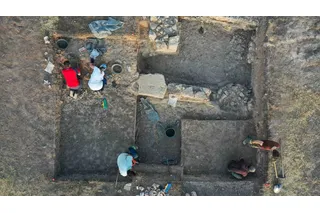


An archaeological site in central France tells the story of human occupation across multiple eras, from the Paleolithic to the Bronze Age to the Middle Ages. Archaeologists have dug up a potpourri of artifacts at the nearly 7-hectare site in the commune of Saint-Laurent-Nouan, suggesting that the area had been a perfect spot to settle for many communities over time.
Excavations have recently taken place at the Saint-Laurent-Nouan site as part of quarrying operations, revealing human occupation dating back 12,000 years. Archaeologists unearthed not only flint blades from this era, but also Bronze Age cooking utensils and Medieval storage pits. Altogether, the evidence presents a prehistoric collage of cultures that lived and worked right near central France’s Loire River.
Read More: Prehistoric Underwater Wall Hints at Sophisticated Human Engineering 7,000 Years Ago
A Paleolithic Gathering Place
The Saint-Laurent-Nouan site is located just over 2 miles from the left bank of the Loire, France’s longest river.
Recent excavations revealed evidence of flints trapped in sandy depressions across three occupation areas, according to a statement by France’s National Institute for Preventive Archaeological Research (INRAP).
Archaeologists believe that the flints were used by hunting camps of the Laborian culture at the end of the Paleolithic. According to a 2020 study in Quaternary International, evidence of the Laborian culture was first identified in southwestern France, but it also extended to northern and western France.

 Explore All Options
The Laborian culture used weapons with pointed stones for hunting. The Saint-Laurent-Nouan site may have appealed to them since it was close to a number of small streams and flint outcrops near the Loire. They likely took advantage of siliceous materials in the area to craft large blades made from carefully prepared flint flakes that they would've struck with stone hammers.
The Laborian culture is also known for its distinct mobiliary (or portable) art, small engraved figurines or sculptures that they would have brought with them from place to place. Their art featured a geometric style, commonly depicting horses and bovines with elongated and disproportionate bodies that were decorated with various patterns, according to France’s Ministry of Culture.
Unearthing Bronze Age Artifacts
The Saint-Laurent-Nouan site continued to be occupied into the Bronze and Iron Ages, as shown by three additional settlements that archaeologists found. The settlements, located around 330 to 500 feet apart, were organized as small, unrefined domestic units.
One unit in particular stands out; attributed to the Late Bronze Age (1150 to 1000 B.C.E.), it contained evidence of three or four buildings that served an unknown function, along with a cluster of structures dedicated to cooking and storage activities, a silo for short-term food storage, and a few scattered pits.
Archaeologists discovered various artifacts at the unit, including ceramic vessels used in the household, circular cooking utensils called “torus,” and a few lithic pieces. Among the recovered artifacts were also firedogs (also known as andirons), which are stands that usually sit on the left and right sides of a fireplace.
According to The Antique Fireplace Restoration Company, firedogs have been used since the time of the Ancient Greeks; in the past, they were commonly used to support spits for cooking meats (today they serve more of a decorative purpose, but they can also help keep a fire burning and well-ventilated).
Occupation During Medieval Times
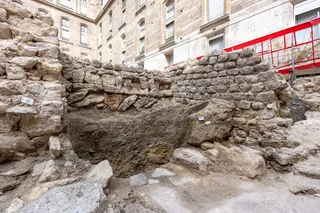
Communities still lived at the Saint-Laurent-Nouan site several centuries after the Iron Age. Southeast of the excavation area, archaeologists found a medieval site dating back to the Carolingian period (9th to 10th century C.E.)
This area consists of a rectangular enclosure around 288 feet long and 190 feet wide, as well as pits that were used for storing plant-based foods like cereals and legumes. Several rows of postholes also signal the presence of other buildings, although archaeologists don’t yet know their exact layout.
According to INRAP, the site will undergo further excavation and study, which could reveal more details about the site's historic occupation from the Paleolithic to the Middle Ages. The current construction site will be open to the public during the European Heritage Days on September 19, 2026.
Read More: These Prehistoric Paintings Are 57,000 Years Old — But Who Painted Them?
Article Sources
Our writers at Discovermagazine.com use peer-reviewed studies and high-quality sources for our articles, and our editors review for scientific accuracy and editorial standards. Review the sources used below for this article:
- This article references information from a study published in Quaternary International: The pleistocene-holocene transition in Southwestern France: A focus on the laborian
- This article references information from France’s Ministry of Culture: Laborian
- This article references information from The Antique Fireplace Restoration Company: Fireplace Facts: What are Firedogs?