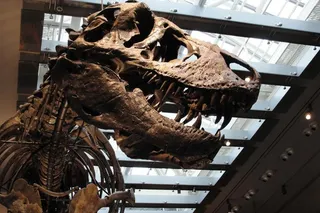


About 66.5 million years ago, a Tyrannosaurus rex walked through an area that is now present-day North Dakota. Where it was headed is unclear; what it left behind, however, were four massive footprints permanently preserved in stone.
Though researchers have uncovered single footprints in the past, these footprints likely represent the first known evidence of an adult T. rex trackway, or sequence of tracks. The findings have been published in the Journal of Vertebrate Paleontology.
“Bones tell us an enormous amount about these animals, but footprints capture a moment of behavior. With a trackway, we can actually follow an animal as it moved across the landscape. That is incredibly rare for T. rex,” Tyler Lyson, senior curator of vertebrate paleontology at the Denver Museum of Nature & Science, said in a press release.
Uncovering a Dinosaur Trackway
Researchers from the Denver Museum of Nature & Science and Liverpool John Moores University in England first uncovered the trackway in 2025 while excavating on U.S. Forest Service land near Marmarth, North Dakota — part of the Hell Creek Formation, a notable fossil hotspot.
The trackway is about 23 feet long, and each of the four preserved footprints is about 3 feet long. Each footprint has three toes, consistent with a T. rex foot. Using 3D scanning technology, the team scanned the full trackway and captured detailed data on the footprints. They then recreated physical 3D reproductions of the footprints.

 Explore All Options
“The technology we’re able to apply in the digital age means my colleagues could scan the tracks in the field and then send the 3D information over to me to visualize on my computer and in VR, enabling me to take as close a look as they did in person,” lead study author Peter Falkingham, a professor of paleobiology at Liverpool John Moores University and a dinosaur track expert, said in the press release.
Taking Giant Strides
Of the four tracks, two were from the right foot, and two were from the left foot. After measuring the T. rex trackway, the team determined that the dinosaur had a stride of about 13 feet and may have walked at about 3.5 to 4.5 miles per hour. This equates to about a brisk human walking pace, according to the research team. The tracks are fairly weathered, so finding the exact stride is more challenging, according to the study.
The team noted that the footprints were cemented with calcium carbonate and are much harder than the surrounding rock. Though many of the rocks in the Hell Creek Formation are from soft sediment, this cementation process — called post-depositional cementation — can happen when groundwater is high in calcium carbonate minerals and flows through porous sediments like sandstone.
What Comes Next for the T. rex Tracks?
In the near future, a team expects to recover the footprints by helicopter and transport them to the Denver Museum of Nature & Science, with the hope of future display.
“As a teacher, I’m always telling my students that science starts with curiosity, passion, and careful observation. I never imagined that could lead me to a discovery like this,” said Kent M. Hups, a teacher at Northglenn High School who discovered the site and co-authored the study, in a press release.
Read More: 16,000 Fossilized Footprints Reveal South America's Forgotten Dinosaur Highway
Article Sources
Our writers at Discovermagazine.com use peer-reviewed studies and high-quality sources for our articles, and our editors review for scientific accuracy and editorial standards. Review the sources used below for this article:
- This article references information from a study published in the Journal of Vertebrate Paleontology: A large tridactyl trackway from the Upper Cretaceous Hell Creek Formation of North Dakota, likely attributable to an adult Tyrannosaurus rex