False killer whales that call the Hawaiian Islands home are remarkable apex predators and an important part of Hawaiian culture. But they are also in trouble. The only surviving member of the genus Pseudorca is now represented by just around 140 individuals in Hawaiʻi, making this population the smallest and most endangered whale population in the United States.
To better understand what is driving their decline, researchers from the U.S. and Japan spent seven years studying the whales. Their findings, published in Endangered Species Research, offer the most detailed look yet at how environmental changes and food shortages may be affecting the population.
“That is why this work is so important,” said study co-author Lars Bejder, director of the Marine Mammal Research Program (MMRP) and professor at the Hawaiian Institute of Marine Biology, in a press statement. “These findings highlight the need to better understand the energetic requirements of these whales and how external stressors may be affecting them.”
Tracking the False Killer Whale Population
The team used high-resolution drone imagery to monitor around half of the remaining population between 2019 and 2025. The aerial surveys allowed researchers to estimate body size and overall condition without disturbing the animals.

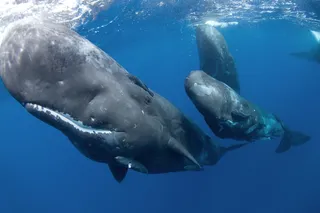
Two false killer whales swim near the Hawaiian islands.
(Image Credit: Pacific Whale Foundation)
What they found was concerning. One whale lost an estimated 28 percent of its body mass, roughly 500 pounds, in just 10 weeks. The population's overall body condition also reached a record low in 2020, coinciding with a severe marine heatwave and the largest single-year population decline on record. According to the researchers, the findings suggest many whales may be struggling to find enough food.

 Explore All Options
“This study is a critical step in understanding whether prey limitation is driving the extinction risk for these whales,” said lead study author Jens Currie, scientist at the Pacific Whale Foundation (PWF) and MMRP, in the release. “Our findings suggest that many individuals are living on a thin metabolic margin. We are now examining how competition with fisheries for high-energy prey like ‘ahi (yellowfin tuna) and mahimahi may be forcing these whales into a state of chronic nutritional stress.”
Read More: Gray Whales Keep Turning Up in Rivers — What Is Driving This Strange Behavior?
Not All Whales Are Affected Equally
The study also revealed significant differences between social groups. Whales belonging to a group known as Cluster 1, which travels widely throughout the islands, showed greater variation in physical condition than other groups. Researchers suspect the energetic demands of covering large distances in search of prey may impose a bigger burden on some animals.
The team further compared drone data with detailed 3D scans of false killer whales in human care at the Okinawa Churashima Foundation in Japan, which allowed them to estimate weight and body volume from aerial photographs with an accuracy of about three percent.
“This level of precision allows us to pinpoint exactly when and where these whales are struggling, which is key for directing conservation efforts,” said Bejder.
“This partnership shows how research facilities throughout the Pacific Ocean can play a meaningful role in global conservation,” said Nozomi Kobayashi, researcher at the Okinawa Churashima Foundation Research Institute, in the statement. “Using precise 3D scans from animals in our care to support the recovery of endangered populations in Hawaiʻi is both powerful and inspiring.”
A Loss Felt Beyond the Natural World
False killer whales are dealing with a wide array of threats, such as climate change, fishing gear entanglements, pollution, and growing competition for prey such as mahi-mahi and yellowfin tuna, as those are heavily targeted by fisheries for human consumption.
With the population declining by an estimated 3.5 percent each year, researchers say establishing a baseline for body condition is a crucial first step toward identifying future health trends, guiding conservation efforts, and fishing restrictions.
“Hawaiian culture has been losing many kūpuna, elders who carry the libraries of knowledge in cultural practices,” said Kaʻapuni, cultural advisor at PWF in the release. “Losing our native population of false killer whales removes even more knowledge from our islands and our history. We cannot afford to lose any more pieces of Hawaiʻi.”
Article Sources
Our writers at Discovermagazine.com use peer-reviewed studies and high-quality sources for our articles, and our editors review for scientific accuracy and editorial standards. Review the sources used below for this article:
- This article references information from a study published in Endangered Species Research: Body condition differs among social clusters and across years in endangered false killer whales in Hawai‘i