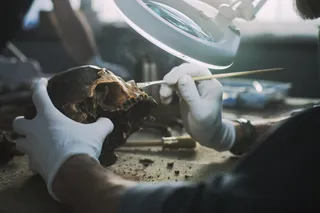


For more than a century, a piece of dinosaur skull sat in London’s Natural History Museum. There were no spectacular jaws to display, no towering skeleton to assemble — just part of the back of a head, collected from the foot of a cliff on the Isle of Wight.
That seemingly unremarkable fragment has now given an elusive predator a name and helped fill a gap in the story of how its relatives spread across the planet.
In a study published in Royal Society Open Science, researchers identified the fossil as Invictibellatrix amberina, a carnivore that lived about 120 million years ago. It’s Europe’s first known megaraptoran, a member of a group whose most intimidating equipment was attached to its arms.
“It is a real mystery that this fossil was overlooked for so long, sitting in a drawer for nearly 100 years. Lots of bones are found on the Isle of Wight — who knows what else is waiting to be discovered,” said lead author Cassitus Morrison in a press release.
Meet the Isle of Wight’s Long-Clawed Dinosaur
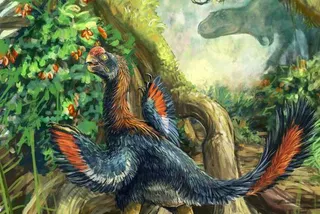
Megaraptorans were agile, two-legged hunters with relatively slender heads, powerful arms, and curved claws. Their anatomy suggests a hunting strategy that leaned heavily on grabbing prey, unlike the jaw-driven approach associated with close relative Tyrannosaurus rex.

 Explore All Options

The skull fragment used to identify Invictibellatrix amberina.
(Image Credit: The Trustees of the Natural History Museum, London/CC BY-SA)
Invictibellatrix was among the group’s earliest and smallest known members. But small is relative when discussing meat-eating dinosaurs.
“Based on what we know about its closest relatives, Invictibellatrix would have been three to four meters [10 to 13 feet] long and just over a meter and a half [5 feet] in height — about as tall as a human,” explained Morrison. “It would likely have had feathers, and its claws might have been about 10cm to 20cm [4 to 8 inches] long. It would have eaten small dinosaurs, lizards, and mammals — occupying a similar role in the food chain to the hyena today.”
Those details are reconstructions based on related dinosaurs, rather than features preserved in the rediscovered fossil. The skull fragment did not come with a matching set of claws.
Its name, Invictibellatrix, means “unconquered female warrior,” anticipating the ecological dominance some later megaraptorans would achieve.
How a Skull Fragment Revealed a New Species
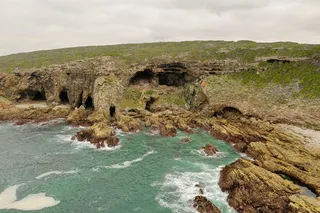
Amateur paleontologist Reginald Walter Hooley originally recovered the fossil along the Isle of Wight’s southwest coast. After his death, the museum acquired the fossil alongside more than 1,000 of his other specimens in 1924.
To work out what it belonged to, researchers compared it with skulls and braincases from several groups of meat-eating dinosaurs, including tyrannosaurs and spinosaurs.
The skull showcased an unusual combination of features, including an oval opening where the spinal cord entered the skull and a crest shaped like an hourglass. Together, the characteristics supported identifying a previously unknown species. Computer analyses comparing its traits with those of other dinosaurs repeatedly placed it among megaraptorans.
Why Europe’s First Megaraptoran Matters
Researchers have proposed that megaraptorans originated in Asia and traveled through Europe toward Gondwana, the southern landmass. Until this discovery, the European stretch of that proposed journey lacked a megaraptoran fossil to back it up.
“This new species is the first proof we have that megaraptorans were also present in Europe and that they reached Gondwana this way rather than island-hopping further south,” said co-author Charlie Scherer.
Models incorporating fossils, evolutionary relationships, geography, and climate suggested the group was widespread during the Early Cretaceous. Later, megaraptorans apparently disappeared from the northern landmass of Laurasia while becoming dominant predators in the south, with some developing claws around 14 inches long.
One skull fragment cannot document every step of that journey, but it puts these mysterious hunters in a place where scientists had long expected to find them — without anyone needing to dig a new hole.
Read More: Rare Fossilized Teeth Fill a Major Gap in Early Mammal Evolution After the Dinosaur Extinction
Article Sources
Our writers at Discovermagazine.com use peer-reviewed studies and high-quality sources for our articles, and our editors review for scientific accuracy and editorial standards. Review the sources used below for this article:
- This article references information from a study published in Royal Society Open Science: A new megaraptoran dinosaur from the Lower Cretaceous Wessex Formation, UK, and its implications for theropod evolution and biogeography