Imagine trying to cross two continents with little more than stone tools and whatever food you could find. According to a new study, early Americans may have solved that problem with one consistent strategy — follow the giants.
Researchers found that the first people to spread across North and South America depended overwhelmingly on enormous mammals, including mammoths, giant ground sloths, ancient camels, and other Ice Age megafauna, for nearly all of their calories.
The findings, published in Science Advances, add fresh evidence to one of archaeology's longest-running debates while also suggesting that humans themselves played a major role in the disappearance of many of these iconic animals.
“Archaeological evidence for Early Paleoindian subsistence, technology and mobility patterns supports the contention that the first continent-wide adaptive strategies in Eastern Beringia, subglacial North America and South America were big game specialists, not dietary generalists,” said the study authors in a press release.
Mammoths and Other Megafauna Dominated the Early American Diet
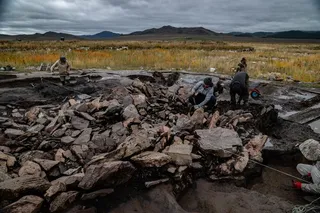
In this study, researchers examined archaeological evidence from three major populations of Early Paleoindians: people living in Eastern Beringia between roughly 14,000 and 13,300 years ago, the Clovis culture of North America, and South America’s Fishtail projectile point people. By combining zooarchaeological records from sites across these regions — including Wyoming’s La Prele Mammoth site — they reconstructed what these early populations most likely ate.

 Explore All Options
Using this evidence, they concluded that as much as 98 percent of the diet of all three regions came from large mammals.
That dietary pattern makes practical sense. Large-bodied animals provided far more calorie-rich meat and fat than smaller prey, which could have helped hunter-gatherers feed entire groups while moving across unfamiliar landscapes. In Eastern Beringia, where the first migrants likely entered the Americas, plant foods were relatively scarce, and archaeological evidence offers little indication that fishing played a significant role.
“Focus on megaherbivores facilitated rapid human expansion into different ecosystems before the […] extinction of megafauna led to regional diversification through adaptations to locally available resources,” explained the study authors.
Read More: Hobbit-Like Hominins May Have Scavenged Komodo Dragons' Leftovers Instead of Hunting Big Game
What Ice Age Mammals Did Humans Hunt?
The prehistoric menu appears to have centered on some of the largest animals ever to roam the Americas.
Mammoths likely ranked among the most important food sources, joined by giant ground sloths, large camels, ancient horse species, mastodon relatives, and other elephant-like herbivores. Rather than occasionally hunting these animals, the evidence suggests they formed the backbone of daily survival.
“Except for the likely opportunistic consumption of easily obtainable fruits or nuts, these highly mobile Early Paleoindians apparently consumed a diet mostly of meats, including both protein and fat,” said the study authors.
The researchers also argue that the absence of widespread evidence for bone marrow extraction isn’t surprising. When hunters had access to such enormous animals, there was little pressure to process every bone for additional calories.
How the New Research Challenges Longstanding Theories
Not everyone has interpreted the archaeological evidence this way. Many researchers have argued that the first Americans were dietary generalists who relied on a broad mix of plants, fish, birds, and small mammals.
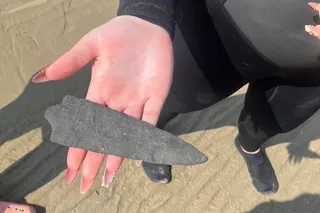
The new study directly challenges that interpretation, with the authors arguing that modern nutritional research undermines claims that humans couldn’t survive on such protein- and fat-rich diets. They also reject suggestions that Early Paleoindians lacked the technology to hunt giant mammals. Stone projectile points combined with atlatls, spears, and coordinated group hunting would have been capable of bringing down mammoths and other megafauna.
Only after these giants disappeared — an extinction the researchers argue overhunting primarily drove — did human diets become far more diverse, expanding to include bison, birds, fish, shellfish, smaller mammals, and plants.
Read More: 1,400 Years Ago, the Bow and Arrow Took Over Western North America —Reshaping Hunting Traditions
Article Sources
Our writers at Discovermagazine.com use peer-reviewed studies and high-quality sources for our articles, and our editors review for scientific accuracy and editorial standards. Review the sources used below for this article:
- This article references information from a study published in Science Advances: Hemisphere-wide evidence of Early Paleoindian megaherbivore specialization