Luis Chiappe had to decide how much of a Tyrannosaurus rex tooth a question was worth. Researchers wanted to drill into two teeth from a young adult nicknamed Thomas to find out how warm his body had been while he was alive around 66 million years ago.
As curator of the Natural History Museum of Los Angeles County’s Dinosaur Institute, Chiappe regularly fields requests to sample irreplaceable fossils. This time, the team had spent more than a decade refining its technique until it needed roughly 90 percent less material.
“Sacrificing small portions of two teeth to learn about T. rex’s body temperature is definitely worth the trade-off,” Chiappe said in a press release.
Thomas’s teeth, along with one from another T. rex, helped researchers measure the dinosaur’s body temperature with this technique for the first time, estimating an average of about 97 degrees Fahrenheit, close to our own. Published in Science Advances, the study adds evidence that T. rex could produce its own body heat, helping it stay active while hunting or scavenging and potentially allowing it to live in colder parts of North America.
How Teeth Recorded T. Rex’s Body Temperature

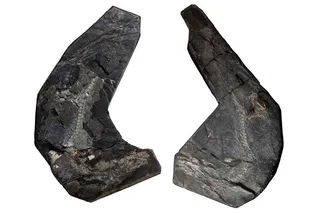
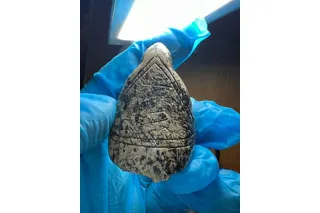
One of the T. rex teeth used to measure the body temperature of T. rex.
(Image Credit: UCLA)
For UCLA geobiologist Robert Eagle and isotope geochemist and climate scientist Aradhna Tripati, the project grew out of discussions inspired by their mentor John Eiler. Working with lead author Randy Flores, they developed a way to extract the information they needed from a few milligrams of fossil material.

 Explore All Options
The team drilled enamel from the teeth and dissolved the powder in acid, releasing carbon dioxide gas. An instrument called a mass spectrometer measured the chemical signature of bonds between heavier forms of carbon and oxygen.
More of these bonds form at cooler temperatures and fewer at warmer ones, allowing researchers to estimate the animal’s body temperature when its teeth grew. Enamel resists chemical changes underground, helping preserve that temperature record for millions of years.
To make the analysis work with less enamel, the researchers pressurized the gas. That delivered a denser stream to the instrument, allowing it to measure what a much smaller sample contained.
Keeping Warm Took More Than Sunshine
To see how T. rex compared with animals from the same ancient environment, the team tested five crocodilian teeth from Montana’s Hell Creek Formation. Those returned an average temperature of about 88 degrees Fahrenheit, roughly nine degrees cooler than the dinosaur’s.
Fossil freshwater shells and computer models helped the team estimate how warm the surrounding water and air had been. Both pointed to temperatures below those inside T. rex.
Thomas’s size may have helped him hold onto heat, since large bodies cool more slowly.
Producing its own heat would have increased T. rex’s food needs.
Where That Warmth Could Take T. Rex
The researchers then combined their findings with ancient climate simulations and the temperature limits of living warm-blooded animals to explore where an animal that kept itself this warm could survive.
Their models identified potentially suitable conditions across much of North America, stretching from Mexico to Alaska. That possible habitat extended beyond the places where T. rex fossils have been found.
Even during the warmth of the Cretaceous Period, northern Alaska experienced freezing seasonal temperatures. Fossils of young tyrannosaurids found there suggest that members of the family stayed through the year, making a living in places where winter brought little warmth.
The new temperature measurements help explain how that could have been possible. Producing body heat could have allowed these animals to keep searching for food as the air around them grew colder.
“For an animal this famous, it is remarkable how little we actually knew,” Tripati said in the press release.
Read More: Small Dinosaurs May Have Had an Evolutionary Advantage Over Their Enormous Relatives
Article Sources
Our writers at Discovermagazine.com use peer-reviewed studies and high-quality sources for our articles, and our editors review for scientific accuracy and editorial standards. Review the sources used below for this article:
- This article references information from a study that was published in Science Advances: The body temperature of Tyrannosaurus rex