

Thomas Jefferson’s legacy has been celebrated throughout American history, but it’s also mired in a controversy that DNA evidence has recently reignited. Historians have long suspected that Jefferson fathered several children with Sally Hemings, an enslaved woman who lived at the former president’s Monticello estate in Virginia. Now, after more than two centuries, an answer has finally come to light thanks to Jefferson’s hair.
In a new bioRxiv preprint paper, researchers found clear evidence of Jefferson’s ancestry in descendants of Hemings after collecting DNA from locks of Jefferson’s hair that were preserved in historical collections. The results suggest that Jefferson himself — not any of his male relatives — did indeed father children with Hemings, confirming a disquieting reality for living members of the Jefferson and Hemings lineages.
A Stain on Jefferson's Legacy
Today, most Americans know Thomas Jefferson for his contribution to writing and signing the Declaration of Independence and his unwavering advocacy for liberty and natural rights. But ever since Jefferson’s time in office, his accomplishments have been clouded by one of the largest presidential scandals in American history.
According to the Thomas Jefferson Foundation at Monticello, Jefferson is said to have fathered at least six of Hemings' children years after the death of his wife, Martha Wayles Skelton Jefferson, in 1782. Four of the children survived to adulthood and are mentioned in Jefferson’s plantation records.

 Explore All Options
Jefferson’s relationship with Hemings quickly became a thorny issue, attracting much attention in the first term of his presidency. The controversy would remain truly unresolved, however; Jefferson made no explicit public or private comment, and Hemings left no known accounts herself. Jefferson’s family denied the reports, with some relatives saying that Jefferson’s nephews, Peter and Samuel Carr, were the potential fathers of Hemings’ children.
Read More: The Mysterious Death of Meriwether Lewis Is Debated — Some Say Suicide, Others Suggest Murder
Revealing the Truth with DNA
Newspapers and books continued to pore over the controversy up until a turning point in 1998, when geneticists tested Y-chromosomal DNA samples from a male-line descendant of Eston Hemings (a potential son of Jefferson and Sally Hemings), as well as male-line descendants of the Carr family and Jefferson family. They found a Y-DNA match between the Eston Hemings descendant and the Jefferson male line, according to the Thomas Jefferson Heritage Society.
The problem, however, was that there were approximately 25 adult male Jeffersons who carried this chromosome living in Virginia at the time, several of whom visited Monticello. Regardless, the researchers believed Thomas Jefferson to be the most plausible father of Eston Hemings, but in the end, the study fell short of finding conclusive answers.
In the new bioRxiv paper, researchers revisited the question of Jefferson’s paternity. They extracted, sequenced, and analyzed DNA from multiple samples of Jefferson's hair, all of which lacked follicles.
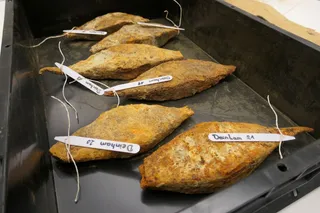
The hairs included locks recovered from several mementos and packets at Monticello; one lock of hair had been placed in a packet with annotations indicating that the hairs were clipped by Nicholas P. Trist, Jefferson’s grandson-in-law, following the day of Jefferson’s death on July 4, 1826.
The researchers also visited with living descendants in the Jefferson and Hemings families, collecting saliva samples from 16 individuals. These included multiple descendants of Eston and Madison, another one of Sally Hemings’ sons. According to the researchers, descendants of her other two recorded children, her son Beverly and daughter Harriet, remain unknown.
Confirming Jefferson's Controversy
With DNA from Jefferson's hair and the saliva samples of the descendants, the researchers evaluated three plausible paternity scenarios for Eston and Madison Hemings: one where Thomas Jefferson is the father, one where Randolph Jefferson (the brother of Thomas Jefferson) is the father, and one where a male child of Randolph (and therefore a nephew of Thomas Jefferson) is the father.
Identifying genomic regions that are identical by descent from Thomas Jefferson and living descendants in the Jefferson and Hemings lines, the researchers suggest that Thomas Jefferson has the highest likelihood (around 99.96 percent) of being the father of at least one of Eston and Madison.
These findings all but suggest that Jefferson fathered several children with Hemings, a scar on the founding father and his legacy that his descendants are left to grapple with today. According to the paper, the Monticello Association has formed a reconciliation committee to address the topic with children of several of the descendants.
"The findings may enable descendants of 'founding father' Thomas Jefferson, whether born to Martha Wayles Jefferson or to Sally Hemings, and whether their ancestral legacy is one of slavery or freedom, to consider themselves as part of one and the same, complicated, American family," the paper's authors concluded.
Read More: Leonardo da Vinci's Notebooks Are Whole Again, 400 Years After a Collector Cut Them Apart
Article Sources
Our writers at Discovermagazine.com use peer-reviewed studies and high-quality sources for our articles, and our editors review for scientific accuracy and editorial standards. Review the sources used below for this article:
- This article references information from a preprint in bioRxiv: The DNA legacy of Thomas Jefferson
- This article references information from the Thomas Jefferson Foundation at Monticello: Thomas Jefferson and Sally Hemings: A Brief Account
- This article references information from the Thomas Jefferson Heritage Society: Thomas Jefferson DNA Study (1998) and the Jefferson–Hemings Paternity Question