While diving with Sama-Bajau communities in Southeast Asia, Erika Schagatay watched people move underwater with circular strokes of their legs, leaving their hands free to gather food. They surfaced to breathe, then descended again, repeating the work for hours.
The physiologist visited diving communities between 1988 and 2025, learning from the Sama-Bajau and Japan’s Ama divers. She and paleoanthropologist Josephine Joordens are now examining whether the demands of working underwater could help explain how our ancestors developed their endurance.
In a paper published online in PaleoAnthropology, the researchers propose that diving for food may have helped our ancestors develop the heart and lung capacity later used for long-distance running. Their “dive first, run later” hypothesis expands on the idea that human stamina evolved by chasing prey until the animals became too exhausted to escape, arguing that some of that endurance may have developed in the water first.
“Our study provides a balanced land-and-water perspective on human evolution,” said Joordens in a press release. “A combination of land-based foraging and foraging in water close to the shore by shallow diving could have shaped the multifaceted humans we are today.”
How Breath-Hold Diving Could Have Shaped Human Endurance
Compared with other apes, humans have a remarkable combination of abilities for sustained running, swimming, and breath-hold diving. The researchers argue that an explanation for our endurance should account for all three.

 Explore All Options
Japanese Ama divers gather shellfish such as abalone through repeated breath-hold dives. An earlier study co-authored by Schagatay recorded two working hours for three female Ama divers aged 40 to 45. One woman made 50 dives, spending 45 percent of that time underwater. Another made 65 shallower dives.
A diver who stays down so long that she needs an extended recovery loses time she could spend collecting food. Shorter dives allow her to catch her breath and return underwater sooner, keeping up a pace she can sustain for hours.
During a breath-hold dive, the heart slows and blood flow shifts to conserve oxygen for organs such as the heart and brain. Between descents, breathing replenishes oxygen supplies.
Looking across species, the researchers found that human diving patterns fall within the range of shallow-diving, semi-aquatic mammals, with a particular resemblance to those of sea otters.
Schagatay and Joordens argue that, over generations, repeated diving could have favored ancestors whose bodies replenished and conserved oxygen efficiently.
To build their case, the researchers brought together earlier studies of diving physiology, comparisons with other mammals, and evidence from ancient human fossils.
What Heavy Bones Might Reveal About Early Divers
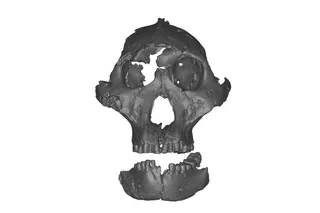
Some early humans had very heavy bones, a feature often explained by the physical demands of their lives. Joordens and Schagatay considered whether that weight might also have helped them find food underwater.
Air in the lungs makes a diver buoyant, requiring effort to descend and stay submerged. Heavier bones can help counter that upward lift, making it easier to remain near food on the bottom.
Lighter skeletons, meanwhile, would reduce the weight carried during running. Different populations may have developed bodies suited to different ways of finding food, with some spending more time foraging underwater and others relying more on land.
Whether underwater foraging explains these differences in ancient skeletons remains a question for future research.
Diving to Feed a Family
Environmental changes around three to two million years ago may have made food on land harder to come by in some places. The researchers think coastal populations increasingly turned to underwater resources, making repeated dives a more regular part of feeding themselves.
Among the Sama-Bajau communities Schagatay studied, that work continues into people’s 60s and 70s. Their ability to keep diving helps support their families, giving the researchers a living example of the endurance they are trying to understand in our ancestors today.
Article Sources
Our writers at Discovermagazine.com use peer-reviewed studies and high-quality sources for our articles, and our editors review for scientific accuracy and editorial standards. Review the sources used below for this article:
- This article references information from a study published in PaleoAnthropology: Dive First, Run Later? The Role of Endurance Diving in Human Evolution