

Pompeii getting buried in ash and rock is far from the only earth-shattering episode of volcanism in history. There was a time when a much more intense volcanic eruption rocked northern Chile, 21.9 million years ago. And instead of covering a mid-sized city, it laid waste to an entire landscape around six times the size of Chile’s capital, Santiago.
Below the volcanic rock deposited by the Lauca Caldera eruption lies a lost landscape that researchers have recently investigated in hopes of learning how the Andes mountain range formed. Their findings, published in a new Science Advances study, indicate that the Andes may have risen slowly over tens of millions of years, rather than ascending more rapidly in the last few million years.
“Pompeii shows how volcanic eruptions can freeze a moment in human history. This study shows that much larger eruptions can also freeze moments in Earth history, burying whole landscapes beneath volcanic deposits and preserving clues to how mountains were being built before the eruption,” said study author Byron Adams, a tectonic geomorphologist at University College London, in a statement.
Read More: Scorching Hot Volcanoes Sculpted Mercury's Crust Before Shutting Down 3.5 Billion Years Ago
More Massive Than Pompeii

Cardones ignimbrite deposits incised by the Lluta River in northern Chile
(Image Credit: Frances J. Cooper/ CC BY-SA)
The Lauca Caldera sits in the Arica y Parinacota Region in northern Chile, where a massive eruption occurred 21.9 million years ago.

 Explore All Options
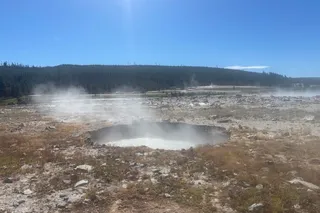
As a caldera, this site appears as a large depression associated with volcanic collapse. Calderas, generally spanning more than 0.6 miles across, are significantly larger than craters, which are only a few hundred yards across, according to the Yellowstone Volcano Observatory.
Compared to the 79 C.E. eruption of Mount Vesuvius that destroyed Pompeii, the Lauca Caldera eruption was enormous; the deposit it left, made of igneous rock called ignimbrite, spans over 300 cubic miles.
In the new study, researchers aimed to find out what the landscape buried beneath this ignimbrite was like. To do so, they simulated hundreds of possible ancient landscapes with the help of models showing how rivers shape mountain ranges.
“We cannot dig down to see the buried landscape, but we can use the shape of the volcanic blanket and what we know about how rivers shape mountains to infer what is hidden beneath it,” said Adams.
The Andes' Slow and Steady Rise
The models allowed the researchers to infer that a low-relief landscape (similar to gentle mountain foothills) was buried under the ignimbrite. This relatively flat land indicated that part of the Andes was built slowly; rocks were pushed up by no more than around 0.10 miles every million years, or about an inch every 100 years.
If the ancient landscape were much steeper, it would have signaled that the Andes rose faster. But the researchers were able to figure out that the landscape was instead flatter, as steep slopes wouldn’t have fit underneath the ignimbrite.
The researchers' findings support the idea that the Andes rose much slower than other active mountain belts, like parts of the Himalayas.
Using Eruptions to Study Mountains
Rates of rock uplift, which allow geologists to understand how mountains are built over time, are often measured in terms of cooling histories. This entails looking at minerals in rocks that recorded specific changes in temperature, showing how the rock cooled as it traveled upward through the Earth’s crust.
However, this method can sometimes be limited to specific timeframes, whereas studying landscapes buried beneath volcanic deposits can provide information on a much longer period, according to the new study’s authors.
Having identified the type of landscape underneath the ignimbrite from the Lauca Caldera eruption, the researchers say that the Andes likely grew slowly and steadily over 40 million or 50 million years rather than popping up in the last 6 million to 10 million years.
“We’ve been working in this part of the Andes for many years to understand how the mountains developed,” said study co-author Frances Cooper, a geologist at University College London. “The Andes have a major influence on regional and global climate, so reconstructing their history is important for understanding long-term climate change.”
The researchers conclude that the study method they used can even be applied to other ignimbrite deposits — including ones in the U.S., Russia, Japan, and several other countries — to gain insight into rock uplift all around the world.
Read More: After a Massive Eruption, This Underwater Volcano Removed Methane from the Atmosphere
Article Sources
Our writers at Discovermagazine.com use peer-reviewed studies and high-quality sources for our articles, and our editors review for scientific accuracy and editorial standards. Review the sources used below for this article:
- This article references information from a study published in Science Advances: Landscapes buried beneath large-volume ignimbrites reveal preeruptive uplift rates
- This article references information from the USGS: Caldera or crater...what's the difference?