Previously, I've discussed the neurogenesis theory of depression in two rather skeptical posts. Not that I'm on some kind of anti-neurogenesis theory crusade, but a study just published adds to the evidence that all's not well with that hypothesis.

The paper is Singer et. al.'s Conditional ablation and recovery of forebrain neurogenesis in the mouse. Via some cunning genetic engineering, the authors created mice with a gene for a protein called herpes simplex virus thymidine kinase. As the name suggests, this is a protein normally found in, er, herpes. Ganciclovir is a drug which can be used to treat herpes and related viral infections. And, as you might expect, cells engineered to express the herpes protein die when exposed to ganciclovir.
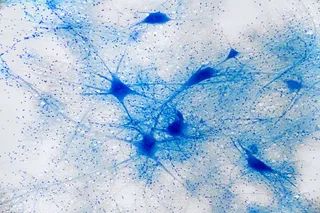
The authors engineered mice which expressed herpes simplex virus thymidine kinase, but only in neural progenitor cells. These are the cells which eventually become new neurones in the adult brain. They found that injections of gancyclovir devasasted the production of new neurones in the engineered mice. (It had no effect on normal mice, of course, because their brain cells weren't half mouse, half herpes). That's not all that surprising.
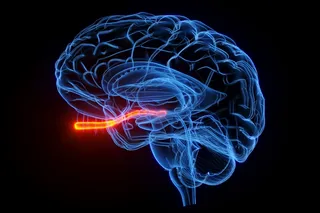
However, they also found that gancyclovir treatment had no effect on the ability of 28 days treatment imipramine, an antidepressant, to affect the mice's behaviour. (The measure of antidepressant action was the Tail Suspension Test). That's a result, because a lot of people are interested in the theory that antidepressants work by boosting neurogenesis in the hippocampus. If that were true, blocking neurogenesis should also block the effects of antidepressants.

 Explore All Options
Some rather exciting experiments found that it does, most famously the much-cited Santarelli et al (2003). But a growing number of other studies, such as this one, have not confirmed this finding. This doesn't mean that Santarelli et al were wrong, but it does suggest that there's more to antidepressants than neurogenesis. The seemingly-contradictory findings of the various studies might be due to important differences in the methods used. For example, the authors of this paper say that Santarelli et al's way of blocking neurogenesis - using x-rays - may have also caused inflammation and blocked the formation of non-neural cells, such as those which go to make up blood-vessels.
Of course, it's easy enough for us to speculate along such lines - rather harder to work out what exactly is going on. With any luck, the next few years will see more progress on this important topic.
Singer, B., Jutkiewicz, E., Fuller, C., Lichtenwalner, R., Zhang, H., Velander, A., Li, X., Gnegy, M., Burant, C., & Parent, J. (2009). Conditional ablation and recovery of forebrain neurogenesis in the mouse The Journal of Comparative Neurology, 514 (6), 567-582 DOI: 10.1002/cne.22052