Deep-Sea Corals Vanished for Over 1,000 Years in the Galápagos — We May Now Know Why
Learn how a dramatic climate shift in the Pacific may have wiped out an entire underwater ecosystem deep below the Galápagos — and it could happen again.
Stephanie Edwards is the Engagement Specialist at Discover Magazine, who manages all social media platforms and writes digital articles that focus on archaeology, the environment, and public health.
Deep beneath the Galápagos, an entire coral ecosystem disappeared for more than a millennium. According to scientists, the culprit was a powerful shift in Pacific climate patterns.
In a new study published in PNAS, researchers reconstructed more than 100,000 years of deep-sea coral history and uncovered a period around 5,000 years ago when these corals simply vanished. The discovery suggests that deep-ocean ecosystems — long thought to be relatively stable — may be far more vulnerable to climate change than expected.
“Understanding the great antiquity of this ecosystem, its sensitivity to change, and the centuries it takes to recover from disturbance will be vital for conservation efforts,” said co-author Laura Robinson in a press release.
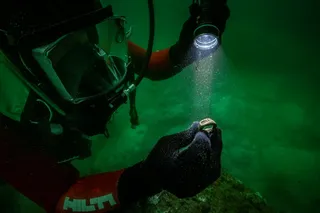
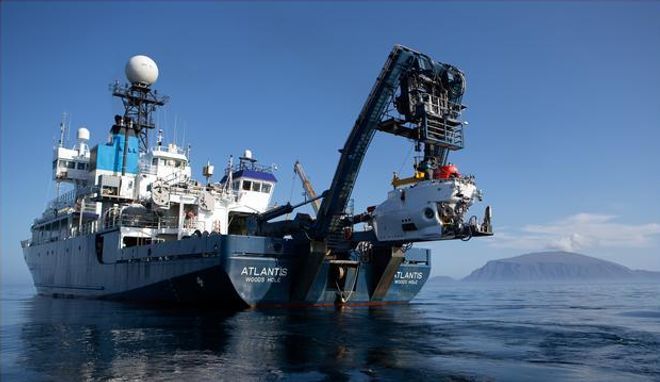
The human-operated submersible used to explore the Galápagos deep-sea corals.
(Image Credit: Lance Willis/WHOI)
Why Did Deep-Sea Corals Suddenly Vanish?
To understand what happened, scientists analyzed more than 900 fossilized deep-sea corals collected from depths reaching over 3,000 feet. Using uranium-thorium dating, they built one of the most detailed timelines ever created for deep-ocean ecosystems.
This timeline revealed that, for tens of thousands of years, these corals survived dramatic global changes, including ice ages and warming periods. But then came an unusual disruption.
“The disappearance of the corals coincided with a prolonged La Niña phase. During that time, stronger ocean circulation brought deep, nutrient-rich water to the surface, which likely led to lower oxygen levels at depth, making it harder for deep-sea corals to survive,” explained lead author Joseph Stewart.
In other words, a climate pattern typically associated with surface ocean changes appeared to have reshaped conditions far below. Increased circulation may have depleted oxygen in deeper waters, creating an environment where corals could no longer survive.
This climate disturbance was not a brief one, either. The coral ecosystem remained absent for 1,000 years before eventually returning, showcasing the potential prolonged effects of climate change on corals.
“The findings challenge conventional thinking. While El Niño events that bring extreme heat to tropical surface waters in the Pacific are well-documented to cause shallow-water coral stress, our study shows that long duration of La Niña-like conditions can also be damaging – especially in the deep ocean,” said Stewart. “Even subtle shifts in global climate patterns can trigger large-scale ecosystem collapse far below the surface.”
Deep-sea corals don’t rely on sunlight like their shallow-water counterparts, but they are no less important. Found in cold, dark waters, these corals form complex structures that serve as habitats for a wide range of marine life.
They act as biodiversity hotspots, supporting fish, invertebrates, and entire food webs in parts of the ocean that are otherwise sparsely populated. Despite this, they remain significantly understudied.
Because they grow slowly and live for centuries — sometimes millennia — deep-sea corals are also natural archives of ocean conditions. Their skeletons record chemical signatures that allow scientists to reconstruct past climates.
This makes their disappearance particularly concerning, as it signals not just a loss of habitat, but also warns of disruption to long-standing ecological stability in the deep ocean.
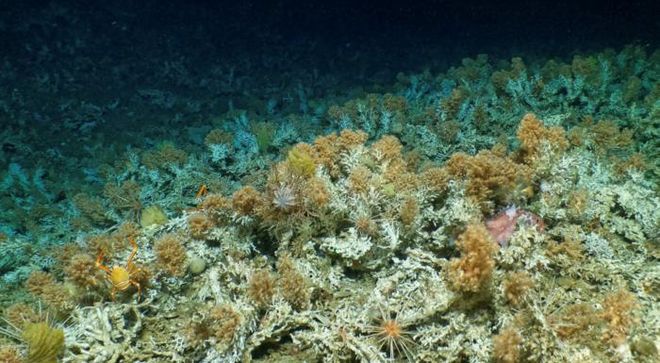
Deep-sea coral reef in the Galápagos.
(Image Credit: WHOI/NSF)
What This Means for Ocean Conservation
The new research offers both a warning and a glimmer of hope. While the fossil record shows that deep-sea corals can recover, that recovery unfolded over extremely long timescales.
“The fact that these coral ecosystems eventually recovered tells us that resilience is possible,” said co-author Stewart Banks. “The challenge for conservation is to safeguard conditions that allow such recovery to happen. In the Eastern Tropical Pacific, this means building Marine Protected Area networks that protect the deep seafloor, supporting natural connectivity between habitats and robustness to climate-driven change.”
That insight is especially important as climate change continues to reshape our global ocean systems, including patterns like the El Niño Southern Oscillation (ENSO).
“This study has implications for how we design and manage Marine Protected Areas, many of which were originally setup to safeguard biodiversity in shallow coastal waters. We also now know that deep, unique, and largely unseen ocean life across the Pacific is also influenced in different ways by changing climate conditions,” concluded Banks.
As the climate shifts, even the most remote ecosystems can feel the impact — and their recovery may take far longer than human timescales allow.
Our writers at Discovermagazine.com use peer-reviewed studies and high-quality sources for our articles, and our editors review for scientific accuracy and editorial standards. Review the sources used below for this article:
Stephanie Edwards is the Engagement Specialist at Discover Magazine, who manages all social media platforms and writes digital articles that focus on archaeology, the environment, and public health.View Full Profile







 Explore All Options