In 52 B.C.E., as Roman troops closed in, a Gallic tribe called the Parisii set fire to their own fortified town rather than let it fall into enemy hands. That town, Lutetia, would eventually become Paris. Julius Caesar, whose forces the Parisii were fighting, wrote that it stood on an island in the Seine.
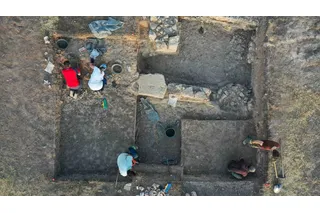
Beneath a courtyard of the Hôtel-Dieu hospital, steps from Notre-Dame, archaeologists have uncovered 65 feet (20 meters) of stone and wood bearing traces of fire. They also found burned seeds and a Gallic spearhead. If the wall belonged to Lutetia, it could be some of the strongest physical evidence yet that Paris grew directly over the Gallic town.
"This discovery fills an archaeological gap," explained Stéphane Deschamps, regional curator of archaeology at the DRAC Île-de-France, in a translated press release. "For centuries, the location of Lutetia has been debated. Lacking tangible evidence on the Île de la Cité, some had even suggested a location in Nanterre. Today, with this wall and its context, we may hold the key to the mystery."
Ancient Wall Beneath Paris Hospital May Belong to Gallic Lutetia

(Image Courtesy of Hamid Azmoun)
The wall appeared during excavations that began in February 2026, ahead of the hospital’s restructuring. David Couturier of the City of Paris archaeology department led the dig with support from France’s National Institute for Preventive Archaeological Research (Inrap). Among the expected traces of earlier homes and roads, the team exposed the wall.

 Explore All Options
"The wall's architecture, with its large blocks and interlocking beam system, immediately led us to believe it was a wall of Gallic tradition," said Dorothée Chaoui-Derieux, a heritage curator at the DRAC Île-de-France.
Fire had blackened the wall’s outer face and destroyed a wooden building just in front of it. Behind the wall, archaeologists found a nearly 6-foot-thick (two-meter-thick) platform of sand and gravel that may have strengthened it, adding to the case that it was a fort.
Read More: This 3,000-Year-Old Pottery May Have Been One of History's First Brands
Fire Damage Raises Questions About the Battle of Lutetia
The team thinks the wall may have protected an oppidum: a fortified center of power and trade that controlled travel routes. In 53 B.C.E., Caesar held an assembly of Gauls at Lutetia. The next year, according to his Gallic Wars, his lieutenant Labienus marched against the Parisii and their allies, led by Camulogenus, an aging commander chosen for his skill at war. The Gauls burned Lutetia and cut its bridges as the Romans got closer. Camulogenus died in the battle that followed.
Carbon dating places wooden elements from the wall between 200 and 10 B.C.E., a range that includes 52 B.C.E. Pottery at the site also dates to Caesar’s era.
“We may be looking at one of the most important remains ever discovered for understanding Gallic Lutetia. Scientific caution dictates that its function and chronology still need to be verified, but the convergence of evidence is particularly remarkable,” said culture minister Catherine Pégard in the press release.
Until now, the case for Lutetia on the Île de la Cité rested on the town’s name and Caesar’s description of an island joined by bridges in a bend of the Seine. In mid-September, France’s Territorial Commission for Archaeological Research declared the find “of exceptional importance.”
Archaeologists Plan to Reconstruct the Wall After Excavation
The fire left the remains extremely fragile, and they lie too deep to keep in place under the building plans. A mould will be made, and after study, a section will be rebuilt with original stones for eventual display in a Paris museum. The team will also record the wall in 3D before removing it.
A reconstruction can preserve the wall’s shape, but not the ground around it. Further excavation will look at what the wall was for, when it was built and abandoned, and what lies beneath the platform. Somewhere in that ground may be the detail that tells archaeologists whether the Parisii built here, and how close this fire was to the one Caesar described.
Read More: Rusty Treasure Hidden in the Danube River May Be Europe's Largest Hoard of Prehistoric Iron Bars
Article Sources
Our writers at Discovermagazine.com use peer-reviewed studies and high-quality sources for our articles, and our editors review for scientific accuracy and editorial standards. Review the sources used below for this article:
- This article references information from the DRAC Île-de-France: Major archaeological discovery in Paris: the rampart of Gallic Lutetia unearthed