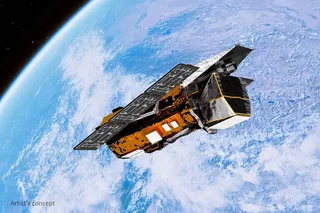
Parker Solar Probe does not carry a dust detector, but when tiny grains near the sun struck the spacecraft at high speed, they vaporized on contact and left electrical traces in instruments built for something else entirely. In effect, the spacecraft had accidentally become a dust detector.
That accidental discovery is at the center of a new study published in The Astrophysical Journal, led by Syed Ayaz, a graduate research assistant at the University of Alabama in Huntsville. The sun’s outer atmosphere, called the corona, reaches temperatures of about 1.8 million to 5.4 million degrees Fahrenheit (1 million to 3 million degrees Celsius). The surface below it sits at roughly 9,900 degrees Fahrenheit (5,500 degrees Celsius). Usually, heat decreases with distance from its source. The sun works backward, and nobody has fully explained why.
Researchers have focused on electrons, ions, and plasma waves to understand how energy moves through the corona. Dust was left out of those models for the most part, assumed too fragile to survive that close to the sun. Parker's data showed it was there anyway. The new study finds that charged dust grains may change how plasma waves travel and where they release their energy, potentially altering where and how coronal heating occurs.

 Explore All Options
“The discovery of dust in the young solar wind by Parker Solar Probe allowed Syed to open up an entirely new and unexpected area of study in solar physics,” said co-author Gary Zank in a press release. “This is very exciting, and Syed realized very quickly that the presence of dust could change how we view the long-standing and open problem of how to heat the solar corona to more than a million degrees.”
Read More: A Solar Probe's Journey to the Sun Has Revealed the Mystery of Solar Flares
What Charged Dust Near the Sun Is Doing
Ayaz focused on kinetic Alfvén waves, a type of plasma wave that can carry electromagnetic energy through the corona and transfer it to particles. Researchers already see these waves as an important part of coronal heating, but most models have treated the region as a mix of electrons, ions, and magnetic fields. Ayaz’s study asks what happens if dust is not just surviving near the sun but also changing how those waves move.
The dust appears to change the waves in two opposing ways. The mass of the dust can make the surrounding plasma harder to move, slowing the waves down. That may allow their energy to travel farther into the corona or young solar wind before it gets released.
The charge of the dust can have the opposite effect. Because the grains are electrically charged, they can strengthen the link between the waves, electric fields, and nearby particles. In that case, the wave energy may be released closer to the dust, heating particles more locally.
The Corona heating problem is not only about how the sun’s outer atmosphere gets so hot, but where the energy is deposited. If dust changes whether energy travels outward or gets released nearby, then it could affect the shape, temperature, and acceleration of the young solar wind.
What Comes Next for Solar Corona Research
The findings shift the question from whether dust can survive near the sun to what that dust is doing there. Parker Solar Probe has already shown that the near-sun environment is more active and variable than expected, and future missions with instruments specifically designed to measure both dust and plasma waves could help determine how much influence those grains actually have.
The bigger question is whether dust near the sun is only passing through, or whether it helps shape how electromagnetic energy becomes heat and solar wind motion. That answer may require missions beyond Parker, but the question itself is new and began with a spacecraft picking up signals it was never designed to detect.
Article Sources
Our writers at Discovermagazine.com use peer-reviewed studies and high-quality sources for our articles, and our editors review for scientific accuracy and editorial standards. Review the sources used below for this article:
- This article references information from a study published in The Astrophysical Journal: Parker Solar Probe Observations of Dust Mass and Charge Densities and Their Impact on Kinetic Alfvén Wave Dynamics in Solar Coronal Heating