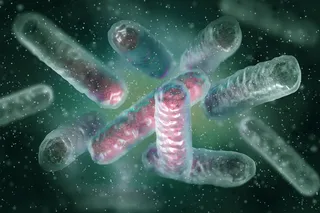
Aidan Taylor wanted to know whether Campylobacter, the bacterium behind hundreds of thousands of food poisoning cases a year in the U.K., could learn to survive a violet-blue light. So his team at the University of Reading exposed one strain to it over 15 rounds, letting the survivors recover before each new exposure to see whether they would come back tougher.
After 15 rounds, the strain was no harder to kill than when it started, meaning the bacterium had not learned to survive the light. The experiment was part of a study in Microbiology that also tested the light against 64 Campylobacter strains collected from U.K. poultry and poultry farms.
The treatment reduced the number of live bacteria in every strain, including strains resistant to several antibiotics, raising the possibility of cutting contamination on chicken carcasses at processing plants before the meat is sold. For anyone who washes their hands a hundred times after handling raw chicken, that could one day mean a little less to worry about.
“What's exciting about this light-based approach is that it doesn't rely on chemicals or antibiotics at all, so it sidesteps the resistance problem entirely. We've shown it works against a wide range of real-world strains taken directly from U.K. poultry, including the multi-drug resistant strains that worry us most,” Taylor said in a press release.

 Explore All Options
How Violet-Blue Light Kills Campylobacter
The technique is called violet-blue photodynamic inactivation. A low-power LED shines 405-nanometer light onto the bacteria, and molecules that occur naturally inside their cells absorb it and produce reactive oxygen species, destructive compounds that kill the cell. The researchers say the light works without touching the food or adding any chemicals to it.
To see how the light worked on strains from farms rather than lab stocks, the team worked with the Animal and Plant Health Agency, which monitors Campylobacter in U.K. poultry. The agency supplied 64 strains of three species, gathered from 2008 to 2024, and many of them were resistant to antibiotics. At the strongest dose tested, the number of live bacteria in every strain fell by at least 100-fold, and neither species nor antibiotic resistance made a significant difference.
Read More: Overlooked Foodborne Parasites Caused an Estimated 171 Million Illnesses Worldwide in a Single Year
Why Campylobacter Is Hard to Control in Poultry
Thorough cooking kills Campylobacter, so most infections are thought to start with raw chicken spreading bacteria to other food and areas in the kitchen. Most people get over it within a week, though the illness can bring fever, nausea, stomach cramps, and bloody diarrhea. The university estimates it costs the U.K. about £700 million (about 928 million USD) a year in medical costs and lost working days.
"Campylobacter is a genuinely nasty bug, and its sheer abundance in the food chain, combined with rising antibiotic resistance, makes it a really difficult problem to tackle,” Taylor said in the press release.
The team estimates that reducing contamination on carcasses a hundredfold could lower the share of highly contaminated ones (more than 1,000 live bacteria per gram of skin) in shops from about 1 in 10 to 1 in 50.
What Must Happen Before Blue Light Reaches Poultry Plants
In this study, the team tested the light on lab cultures, and a processing plant is messier. In slaughterhouses, Campylobacter can form biofilms, thin layers of bacteria that may block light from reaching the cells beneath, and bacteria on chicken skin may tolerate more exposure than the ones in liquid tested here, according to the paper.
“The consistent results observed across multiple species and resistance profiles are highly encouraging. While further evaluation using contaminated meat samples is required, the simplicity and adaptability of this technology suggest that it could be implemented at various stages of the food production process," co-author Samuel Connelly said.
If the light works as well on chicken in a real plant as it did in the lab, fewer people could end up spending a week sick with a fever and stomach cramps.
This article is not offering medical advice and should be used for informational purposes only.
Read More: How 31 Billion Chickens Are Driving the Evolution of a Major Foodborne Pathogen
Article Sources
Our writers at Discovermagazine.com use peer-reviewed studies and high-quality sources for our articles, and our editors review for scientific accuracy and editorial standards. Review the sources used below for this article:
- This article references information from a study published in Microbiology: One light to rule them all: photodynamic inactivation of diverse Campylobacter Open Access