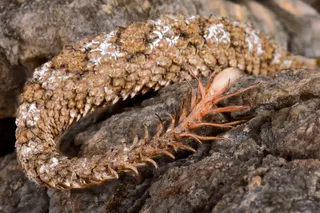
A newly discovered spider species has developed a highly sophisticated trap that catches an aggressive tree ant many other predators would avoid. Home to the rainforests of northern Queensland, Australia, the arachnid, nicknamed the "ballista spider" after the ancient projectile-launching weapon, creates a snare triggered by only a single ant species. Once activated, the ant is propelled into the spider's net with an acceleration far beyond what humans could withstand.
Researchers from Macquarie University in Australia and the University of Greifswald in Germany studied the ballista spider's trap mechanism in its natural environment and tested the durability of its silk. They published their findings in Current Biology.
“This seems to be the only case where a spider’s web is designed to catch a single prey species, and where the mechanism is triggered by the prey rather than by the predator,” said Ajay Narendra, professor at the School of Natural Sciences at Macquarie University, in a press statement.
A Highly Specialized Trickster Discovered in the Australian Rainforest
The ambushing spider was first observed by Greg Anderson, a biomedical researcher, spider taxonomist, and photographer. His discovery prompted scientists at Macquarie University to venture into the rainforests of northern Queensland to take a closer look at this ingenious arachnid hunter.
During their 10-day stay in the Australian jungle, the researchers used high-speed and infrared cameras to capture the spider's behavior. Their observations revealed that the snare, built by a spider in the genus Propostira, differs from those of other animals that use slingshot-like mechanisms to catch non-specific prey. Instead, it is selectively triggered by a single ant species.

 Explore All Options
“It’s very unusual for a spider to feed on ants, because they’re notoriously dangerous, and even more bizarre to find a spider that eats only one particular ant species,” said Narendra. “Ants have a range of chemical defenses — including the ability to sting in some species — and they use alarm signals to rapidly recruit hundreds and even thousands of other ants as backup to overcome potential predators.”
Read more: How Evolutionary Traps Plague the Animal Kingdom
How the Snare Works
The spider's sophisticated trap requires considerable preparation. The ballista spider hides beneath leaves near areas where its preferred prey, the green tree ant (Oecophylla smaragdina), forages during the day. At night, it rappels to a lower structure frequently crossed by ants and creates an anchor point. Over several hours, the spider constructs an intricate catapult consisting of 15 to 60 silk tension lines, leaving a visible cone on the ground.
The spider then waits. When a green tree ant becomes stuck to the cone, it attempts to free itself by biting the silk. Unknowingly, this action triggers the snare. Launched with an acceleration exceeding 4,265 feet per second squared, the ant is flung into the predator's net about 12 inches above, where it is quickly devoured once fully entangled.
“We suspect during the final construction stage the spider adds a pheromone that specifically lures worker ants and induces an aggressive attack, triggering the snare,” added Narendra.
A Surprisingly Powerful Silk Shakes an Ant's Foundation
Fascinated by the properties of the newly discovered spider's silk, researcher Jonas Wolff of the Zoological Institute and Museum at the University of Greifswald collected samples for further analysis in the laboratory.
“The ballista spider’s snare is bioengineered to store elastic energy in the silk and rapidly release it, giving it incredible instantaneous power density — greater than any other [specialized] silk-based biological catapults,” explained Narendra. “The ants it preys on have adhesive pads on their feet, so the contraction of the bundle of tension lines has to overcome a force of many times the ant’s body weight to lift it.”
The findings show how a spider species that has yet to receive an official name evolved a way to prey on some of the most aggressive insects in its environment. In doing so, it has developed a remarkably effective hunting strategy that even impresses human engineers.
Read more: Spiders May Seem Creepy — but A World Without Them Is Far Scarier
Article Sources
Our writers at Discovermagazine.com use peer-reviewed studies and high-quality sources for our articles, and our editors review for scientific accuracy and editorial standards. Review the sources used below for this article:
- This article references information from a study published in Current Biology: Ballistic high-powered spider webs overcome dangerous prey defenses