Sami Solanki studies the sun for a living, but after dark on May 10, 2024, he stepped outside in Göttingen, Germany, with a camera as a hobbyist, not planning to use his photos for science.
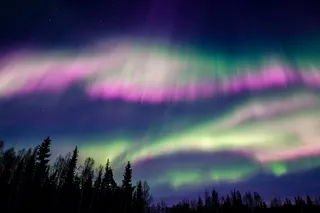
Two photos taken that night, one by Solanki and one by a colleague in Braunschweig, show rays of light running without a break from a red glow into a green one below, a new study in Annales Geophysicae reports, pointing to fast electrons from space as the likely cause of both.
Few instruments have ever measured what lights up red auroras far from the poles, since they form in thin air so high up, leaving researchers to rely on indirect clues like photos from the ground.
Solanki directs the Max Planck Institute for Solar System Research, but that night he was just another spectator, watching something he rarely gets to see over Göttingen.
“I’ve seen many auroras at higher latitudes. Above Göttingen, they’re a rarity. I absolutely wanted to photograph them. I wasn’t originally interested in using the photos for scientific purposes,” Solanki said in a press release.
What Did the Aurora Photos Over Germany Show?
The magnetic storm that night, a disturbance in Earth’s magnetic field set off by the sun, was the second strongest since 1958, powerful enough to push auroras far away from the polar regions where they usually appear.

 Explore All Options
Philipp Schulz, who works at a Fraunhofer research institute in Braunschweig, captured the scene with a Google Pixel 7 phone; the constellations Cygnus and Lyra are visible behind the glow, while Solanki used a camera on a tripod.
Both pictures show bright streaks slanting down through the red glow and carrying on into the green one, and according to the authors’ knowledge, nobody had reported such streaks before.
“Rays continuously connecting the red aurora above to the green aurora below have not been reported in any scientific paper,” said Bruce Tsurutani, the study’s first author, who previously worked at NASA’s Jet Propulsion Laboratory.
Read More: NASA Hopes to Unlock Secrets Behind Northern Lights, Including Black Auroras
Why Red Auroras Are So Hard to Explain
Both colors come from oxygen atoms that glow after electrons hit them, with green forming roughly 50 to 80 miles up and red roughly 125 to 500 miles up, where the air is thin enough that collisions with other molecules do not stop the red glow.
Since the 1960s, scientists have offered competing explanations for the red glow, including heat flowing down from space and waves that speed up electrons, and the unbroken streaks argue against several of the older ones.
Electrons travel along Earth’s magnetic field lines, so streaks that follow the field point to electrons as the cause, and that argues against heat flow and several other older ideas.
“The fact that the bright rays extend from the red to the green aurora suggests that the same physical process is at work in both cases,” said Yasuhito Narita, a professor at the Technical University of Braunschweig who coordinated the international team.
How You Can Help Study the Next Aurora
The authors call their paper a citizen science report, since no instrument measured what caused the red glow directly and the evidence is photographs taken by people on the ground.
It rests on a handful of pictures from one storm, and a photo from earlier that evening shows red and green patches apart with no streaks, while the authors say there are probably several kinds of red aurora.
They want more photos, taken with a shutter open for 6 seconds or less so the streaks show up and the stars stay as points, and they ask people to send pictures to the team in Braunschweig.
The sun is moving away from the peak of its 11-year cycle, though strong eruptions can still occur.
“Anyone who takes photos of the aurora with a smartphone or camera can contribute to their study,” Narita said.
Read More: The Aurora Borealis Like You've Never Seen It
Article Sources
Our writers at Discovermagazine.com use peer-reviewed studies and high-quality sources for our articles, and our editors review for scientific accuracy and editorial standards. Review the sources used below for this article:
- This article references information from a study published in Annales Geophysicae: High temporal- and spatial-resolution photographs of the “Christmas” red-green auroras taken over Germany during a main phase of the 10–11 May 2024 superstorm