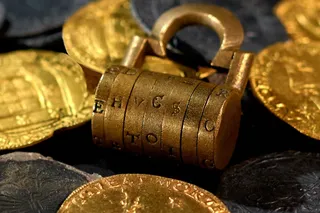
Digging at the site of a new fire station — a former sports field — in Thuringia, Germany, archaeologists turned up a few coins more than 2,000 years old. Eleven coins total eventually came to light, strewn across a strip of earth about 19 feet long and 5 feet wide. No trace of their presumed container survived, so archaeologists relied on the coins' positions to establish that they belonged to one hoard (a group of valuables hidden together).
Excavation director Ronny Krause found several of them in the summer of 2025, while the Thuringian State Office for Heritage Management and Archaeology investigated the site, northeast of the town of Singen.
When the team searched the surrounding ground in August 2026, it confirmed that the 11 coins, dated to the 1st century B.C.E., belonged to a single Celtic hoard, the largest of its period known from Thuringia, according to the office. They are Prague-type quinarii, a coin type named after a small Roman silver coin, and the office says only about 80 were known from the whole state before this find.
How Archaeologists Linked Scattered Celtic Coins Into One Hoard
On their own, the coins did not make a hoard, because they were apparently scattered by a plow. The office presumes they were once kept together in a container made of organic material, and no pieces of a ceramic pot turned up either.

 Explore All Options
Archaeologists call the hoard a closed find, a term for a deposit they believe is complete, with every coin that was hidden together now accounted for. Position records like these are often lost when metal objects are dug up one by one through illegal metal detecting, with no record of where they came from.
The same ground also held a Roman denarius (a common Roman silver coin) from sometime around 164 to 169 A.D., an early medieval red and yellow glass bead, a piece of an iron knife whose age is unknown, a folded silver coin from the mid-1500s, and a button from a Prussian uniform dating to the 1800s or 1900s.
Read More: 400 Gold Coins Recovered From 17th-Century Shipwreck Shed Light on Dutch Trading History
What the Singen Coins Reveal About Celtic Trade
The office presumes the coins came from a mint in the Gotha area, northwest of the find site. Singen's location also links it to Celtic sites in southern Thuringia, among them the Steinsburg near Römhild, a large settlement with workshops for various crafts. Mapping finds of the same age and culture helps researchers work out trade routes and where goods were made, and the office says the hoard adds a great deal to what researchers already knew about the region.
Celtic coinage began in the early 3rd century B.C.E., inspired by Greek coins such as those of Philip II of Macedon and Alexander the Great, according to the World History Encyclopedia. Early designs imitated Greek models before becoming more distinctive, with stylized horses a common motif. Makers cast metal blanks in clay molds, sometimes 50 or more at a time, and then stamped them with dies.
Why People Buried Celtic Coins
The announcement does not say why the Singen coins were buried, though the encyclopedia notes that Celtic coins were sometimes buried for ritual reasons. At Hallaton in England, archaeologists found more than 5,000 coins in 16 separate places, near the remains of sacrificed animals.
Why the Singen coins were buried, and why they stayed underground, is unknown; however, their recorded positions have allowed archaeologists to put back together what the plow pulled apart.
Read More: Rusty Treasure Hidden in the Danube River May Be Europe's Largest Hoard of Prehistoric Iron Bars
Article Sources
Our writers at Discovermagazine.com use peer-reviewed studies and high-quality sources for our articles, and our editors review for scientific accuracy and editorial standards. Review the sources used below for this article:
- This article references information from the Thuringian State Office for Heritage Management and Archaeology (TLDA): Celtic coin hoard at Singer Berg in Stadtilm-Singen, Ilm district
- This article references information from World History Encyclopedia: Celtic Coinage