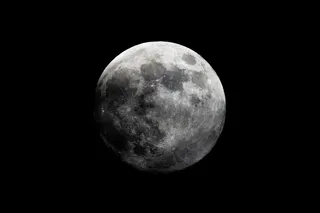


When eager night sky viewers step outside on the evening of April 1, 2026, they’ll be treated to a view of April’s Pink Moon. And fitting for a night that falls on April Fool's, the moon won't take on a rosy hue. It will appear as it normally does, full and bright — hopefully there are clear skies for optimal viewing.
April’s full moon will also mark the first full moon of spring and is the Paschal Moon. The full Pink Moon will reach its peak at 10:12 p.m. Eastern time, in the U.S. (9:12 p.m. Central time and 7:12 Pacific time), according to the Old Farmer’s Almanac. Depending on your location across the globe, the full moon may be visible in the early hours of April 2, 2026.
Learn more about how the Pink Moon got its name and the cultural significance this first full spring moon has for people around the world.
Read More: Apollo Rocks Reveal The Moon’s Magnetic Field Was Both Strong and Weak
The Best Way to See the Pink Moon
On the evening of April 1, 2026, after the tricks and pranks of the holiday have finished, you can head out to see the Pink Moon. For the best view, try to find an open area, away from city lights and other light pollution. You still can see the bright moon within a city, but the dark surroundings will add to the ambiance.

 Explore All Options
Next, keep an eye on the eastern/southeastern horizon and wait for the moon to rise. According to the Old Farmer’s Almanac, as the moon comes over the horizon, it will appear larger than usual, thanks to moon illusion.
This illusion becomes noticeable when we see the moon high in the sky, and we compare it to the vast expanse of the sky around it. But when the moon comes up over the horizon, we compare it to objects on Earth, and it appears much larger.
Once the moon begins to rise over the horizon and appears full and bright in the sky, instead of a glowing pink color, it will give off a golden hue. Make sure you dress for the weather and bring chairs or blankets to sit on if you’ll be spending extended periods outside. While you will be able to see the full moon with the naked eye, it’s never a bad idea to bring binoculars or a telescope with you.
Why Is it Called the Pink Moon?
The Pink Moon gets its name not from the color but from various traditions. For example, according to the Old Farmer’s Almanac, the name ‘Pink Moon’ refers to the blooming of a pink wildflower known as creeping phlox or moss phlox (Phlox subulata) in North America. The flower is typically in bloom around the time of April’s full moon.
April’s full moon has been referred to by several other names. In Algonquin, it is known as the ‘Breaking Ice Moon,’ and in Anishinaabe, as the ‘Sucker Moon.’ In Cree, it is called the ‘Frog Moon.’
Some have also referred to it as the ‘Egg Moon’ as certain animals begin laying eggs during this time of year.
Spring’s full moon also has religious connections. In Christianity, the full moon dictates the date of Easter. The religious holiday falls on the first Sunday after the Pink Moon. This moon is often referred to as the Paschal Moon, the first full moon after the spring equinox.
Read More: NASA Unveils Roadmap for Permanent Moon Base and Increased Missions to the Moon
Article Sources
Our writers at Discovermagazine.com use peer-reviewed studies and high-quality sources for our articles, and our editors review for scientific accuracy and editorial standards. Review the sources used below for this article:
- This article references information from the Old Farmer's Almanac: April 2026 Full Pink Moon: Paschal Moon Meaning, Folklore & Best Viewing Tips
- This article references information from the Old Farmer's Almanac: The Moon Illusion: Why Does the Moon Look So Big Tonight?