Overnight, two mole-rats trashed a neatly arranged space, ripping the paper strips laid out across the floor into shreds with their oversized front teeth, hauling the scraps to one side, and piling them into a bed before huddling together in the heap to sleep.
The space is round and featureless, with nothing to tell one direction from another, yet by morning their nest sits in the southeast, the direction mole-rats like these tend to choose. When researchers shift the space, changing the direction of the next, the mole rats shift the nests along with it, following Earth’s magnetic field.
“You see these animals reacting to things, and you’re in that same room, and you’re like, there’s nothing here, right?” Pascal Malkemper, a group leader at the Max Planck Institute for Neurobiology of Behavior in Bonn, Germany, who has spent more than a decade trying to work out how the animals do tap into Earth’s magnetic field, told Discover. “How the hell are they doing this?”

Mole-rat experiment on Earth's magnetic field.
(Image Courtesy of Pascal Malkemper)
Malkemper was supposed to be studying Parkinson’s disease. After his master’s degree, he turned down a job working on mouse models of the illness, the path “everyone told me you should go,” to chase something stranger — how animals sense the things we can’t.

 Explore All Options
Researchers have known since around 1990 that mole-rats carry a compass, but nobody knows where it is. “Finding out how animals sense magnetic fields is kind of the holy grail of the field,” Malkemper said. “It’s not known for any animal.”
We live inside the same field, and most of us never notice it. The magnetic field runs through everything, including your computer or phone screen, your morning coffee, and even the chair you may be sitting in. It’s weaker than a fridge magnet, and we feel it about as much as we feel the planet spinning. If we think about it at all, it’s thanks to a grade-school science lesson and a compass needle swinging north.
“No matter where you are in the world, you’re surrounded by the Earth’s magnetic field,” said Bryan Keller, who studied shark navigation for his Ph.D. at Florida State University and now works at NOAA Fisheries. Keller has also spent years testing whether sharks can read that field, and he still can’t imagine what reading it feels like.
“I’ve thought about it so many times. What is it like to sense a magnetic field?” he said. “It’s like trying to explain to someone what ice cream tastes like if they’ve never tasted anything.”
Sea turtles, salmon, pigeons, and sharks, to name a few, know the taste well. They use the field to find their way, some of them across entire oceans. Desert ants rely on it to remember where their nest is, and red foxes may even use it to line up their pounces on mice hidden under the snow.
Researchers have three main ideas about how the sensing could work. The first involves magnetite, tiny magnetic crystals that some bacteria grow in chains. The second, and the leading explanation in migrating birds, is a chemical reaction in the eye. The third is electromagnetic induction, the same physics that lets a generator make electricity.
So far, none of the three has been confirmed in any animal and traced to the brain. That missing piece is why people like Malkemper and Keller have spent years coaxing answers out of animals that can’t talk back. Find the sensor, and researchers could finally say whether the magnetic sense deserves to be called a sixth sense, check whether humans carry any trace of it, and learn whether the electronic noise we’ve added to the world is getting in its way.
Read More: Earth's Magnetic Field May Influence Aging by Affecting How Mitochondria Produce Energy
Sensing Earth’s Magnetic Field
Malkemper first met mole-rats during his Ph.D., in his supervisor’s lab. Ansell’s mole-rats are cute, sociable rodents from Zambia that live in the dark, furry cousins of the naked mole-rat. And they are mammals, “as closely related to us as it gets, probably, with a magnetic sense.”
Two experiments pointed to the mole-rats’ eyes, which are only about 2 millimeters across. When researchers numbed the animals’ corneas with the same kind of drops an eye doctor uses, the mole-rats still built nests but lost their usual preference for the southeast. A later study by Malkemper and colleagues found the same thing after removing the eyes altogether.
One leading suspect was magnetite, the first theory behind magnetic sensing. Its tiny crystals swing into line with Earth’s field “like little compass needles,” Malkemper said. If an animal’s nerve cells held such crystals, the pull of the field could tug open a channel in the cell and set off a signal.
So Malkemper went looking for the magnetite crystals themselves. Because they would be far too small to see with an ordinary microscope, his team took slices of mole-rat eye to three synchrotrons –- giant ring-shaped particle accelerators whose X-rays can map where iron sits in a sample. They also used a quantum diamond microscope, which can detect the magnetism of a single tiny particle.
“We looked for these crystals, and we just couldn’t find them,” he said. Most of the iron they did find came mixed with titanium and chromium, a sign it was contamination rather than something the animals had made.
In a study published in iScience in 2026, his team reported no evidence for magnetite-based receptors in the mole-rat eye.
“Either the idea how they sense the magnetic field is wrong,” he said, “or the location is wrong.” It was, he admitted, “a bit frustrating.” Now he’s chasing both leads, a different kind of sensor in the eye or a different spot altogether.
In the eye, his team has turned up “an interesting cryptochrome,” the light-sensitive protein behind the second theory on magnetic sensing. In migrating birds, the theory goes, light striking cryptochrome creates a short-lived pair of reactive molecules, and a quantum effect makes their behavior shift slightly with the direction of the field. Mole-rats, though, live in the dark. “Maybe there’s another way they make this work,” Malkemper said.
Read More: 41,000 Years Ago, Earth's Magnetic Shield Nearly Vanished — Now We Know What It Sounded Like
Could it Be a Sixth Sense?
Whatever the sensor turns out to be, Malkemper has no doubt the sense is real. Asked whether it counts as a sixth sense in animals, he told Discover, “I totally think so.” To him, it’s no stranger than infrared sensing, “just an extension of the spectrum.”
“I don’t think it’s kind of a gut feeling for these animals,” he added. Without a receptor, he admitted, the label is “very tricky.” Still, “whether it’s the sixth or the seventh depends on how many you want to include in the list.”
The number of senses was never really five to begin with. By some counts, humans have anywhere from 22 to 33 senses, including balance, temperature, pain, and the sense of where our own limbs are. Fish, sharks included, feel tiny pressure ripples through a line of sensors along their flanks.
“That’s why if you’ve ever tried to scoop a little minnow out with your hands in a lake, it always knows you’re coming,” Keller told Discover. Sharks also carry jelly-filled pores on their snouts that pick up the faint electric fields of living prey. Keller has watched bonnetheads, sharks with shovel-shaped heads, find shrimp buried completely out of sight. “It’s like a fish detector instead of a metal detector,” he said.
Scientists know where sharks’ electric sense sits, but not their magnetic one. Some researchers think those same pores could be part of the answer, through the third theory, electromagnetic induction. Move anything that conducts electricity through a magnetic field, and a faint current appears. As a shark swims through Earth’s field, its pores might pick up those tiny currents.
Others, Keller said, suspect a separate sensor in the nose. So far, no one has shown which, if either, is right. Still, if Keller had to pick a sixth sense for sharks, “magnetic-based navigation would be a good winner.”
Keller studied that sense in bonnetheads. They’re the hammerhead family’s small fry, about four feet long when fully grown. From April to November, they cruise the estuaries of the southeastern U.S., “just hammering blue crabs,” Keller said. All that crab fuels one of the shortest gestation periods of any shark, four and a half to five months. (By the end, a mother can be “jam full of babies.”)

Bonnetheads swimming in a holding tank to study Earth's magnetic field.
(Image Credit: Bryan Keller)
When the water cools, they swim south, sometimes hundreds of miles. Then they come back, and not to just any estuary. Biologists in South Carolina kept recapturing the same tagged sharks in the same rivers, year after year. The sharks were swimming past estuaries “virtually identical” to their own to get back to the one they’d left. “For lack of a better term,” Keller said, “it’s like their home.”
Because bonnetheads return to one particular place, Keller could test whether they know where they are, and they’re small enough to fit in a tank. “We couldn’t do the study that we did on a great hammerhead or a great white shark,” he said.
What Keller wanted to know was whether sharks use the field as a map. A compass tells an animal which way it’s facing. A map tells it where it is. Earth’s field can supply both. Its strength and the angle at which it dips into the ground change from place to place, so each stretch of coast has its own rough magnetic signature.
Inside a large cube of wire coils that could recreate the magnetic field of other places, he tested 20 juvenile bonnetheads under three magnetic signatures. The first was home, in the Florida Panhandle. The second was a spot about 370 miles (600 kilometers) south, out in the Gulf of Mexico (now renamed the Gulf of America in the U.S.). The third was the same distance north, in Tennessee, where no bonnethead has ever been.
In the home field, the sharks swam at random. When the field said they were 370 miles south, they turned north, toward home. The sharks seemed to read their position, which is what a map does.
“I wasn’t surprised that the animals have this ability,” Keller told Discover. “I was surprised that our experiment picked it up.” Researchers had been asking for 50 years whether sharks use Earth’s magnetic field to find their way. His study, published in Current Biology in 2021, offered experimental evidence that they do.
The Tennessee field drew no reaction at all, possibly because these sharks never experienced anything like it. North of their home waters is land, so they only ever travel south, where the field gets weaker. Keller thinks the sharks learn what those changes mean as they migrate, perhaps on their very first trip, feeling the field weaken as they head south and strengthen again as they come home.

Bonnethead magnetic field experiment.
(Image Credit: Keller et al./Current Biology)
“I think it probably means that it’s a learned behavior,” he said.
But sharks born with a built-in map could react the same way, if that map only covers the waters bonnetheads actually use. The study can’t say which explanation is right, and it could be a mix of both.
What About Humans?
If sharks can read the field, and maybe even learn what it means, could humans sense it on some level, too? In 2019, a Caltech team co-led by geobiologist Joe Kirschvink sat 36 volunteers, one at a time, in a dark, shielded chamber and rotated an Earth-strength magnetic field around them while electrodes tracked their brain waves.
In some participants, the brain’s resting alpha rhythm dipped after certain rotations, a sign the brain had registered something. The dips appeared only when the field pointed down into the ground, as it does in the Northern Hemisphere. (As a control, the team also wired up a cantaloupe. Its signal never dipped.)
Afterward, none of the volunteers could tell when, or even whether, the field had changed. Their brains seemed to register something the volunteers themselves never felt.
A brain response like that, Malkemper noted, “doesn’t mean that we have a magnetic sense.” In his own pitch-dark coil room, he can’t tell where north is. “But I also haven’t tested myself 1,000 times with guessing,” he said to Discover, “and maybe I can actually do it.”
The human research, he warned, is “full of failed replication.” A test must be completely blind, because people, like animals, are good at picking up cues without realizing it.
But Malkemper won’t rule out the possibility that humans once had the sense. Our hunter-gatherer ancestors “needed to navigate way more efficiently than we do nowadays,” he said, and “maybe some of the capabilities that we once had got lost, or we don’t know how to use them anymore.” Whether anyone can still do it, he added, is “tricky to say.”
“Our ancestors were surely more attuned with their environments than we are now,” Keller said. Ask most people to find their way home from somewhere they’ve been only a couple of times, and “they’re pulling out their phone.” Some people even type in their own address to get home from work. “We’ve lost a lot of our touch points with nature,” he noted.
To learn whether any trace of the sense survives in us, Malkemper said, researchers first need to pin it down in animals. Find the receptor in a mammal, like a mole-rat, learn its genes, and “we can easily look at humans and see if there’s any remnants of this.”
Read More: Gigantic Hot Rock Blobs Have Impacted Earth's Magnetic Field For Over 200 Million Years
Pigeons Point the Way
Some of the newest leads in that search come from pigeons. In a study Malkemper co-authored, published in Science in November 2025, researchers shifted the magnetic field around birds whose heads were held perfectly still, and a brain region wired to the inner ear’s balance organs lit up.
That region normally responds when the head moves. Since these heads couldn’t move, the response had to come from the field itself. It was evidence pointing toward the inner ear, and possibly the induction idea, though not yet a complete path from sensor to brain.
“I find it one of the most intriguing findings in the last 10 years,” Malkemper said. “But we have to see. I wouldn’t bet my life on it.”
In May 2026, a different team reported in Science that pigeons may also get help from an unlikely organ, the liver. The researchers found iron-rich immune cells there, and when they depleted those cells, the birds lost their sense of direction on overcast days but had no trouble when the sun was out. No one has yet shown how a signal from the liver would reach the brain.
“I’m not convinced yet,” Malkemper told Discover. “We’ll see what future studies show.”
Pigeons hint that there may be no single answer. They show evidence of as many as three sensors, and different animals may have evolved different ones.
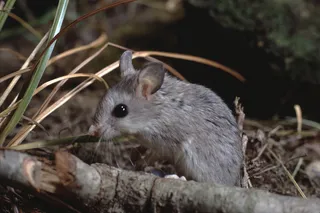
In Malkemper’s own work, wood mice, which live above ground, respond to weak radio waves of the kind known to disrupt the cryptochrome compass in birds, while his mole-rats, living in darkness, ignore them. Even among mammals, he said, “there might be two different mechanisms at work for some animals that have light available and others that don’t have light available.”
Read More: Earth’s Magnetic Field Flips Regularly — Some Reversals Last 70,000 Years
Static in the Air
It may be too early to say whether humans have this sense, but we may already be getting in the way of animals that do. Human-made electromagnetic noise can interfere with the magnetic sense, at least “in principle,” said Malkemper, who sits on an international committee that advises on radiation protection. “There are concerns.”
Take the European robins that biologists kept in wooden huts on the University of Oldenburg campus in Germany. Surrounded by the city’s background electromagnetic noise, the birds couldn’t use their magnetic compass. In huts lined with grounded aluminum, which cut that noise roughly a hundredfold, they oriented again. Remove the grounding, or pipe noise back in, and the compass failed once more.
Still, Malkemper doesn’t want to overstate the risk. Ordinary cellphones aren’t among the sources he worries about most, since their frequencies are probably too high to affect any of the proposed sensors. The radio signals that can cause trouble are local.
“You have to have the right frequency at the right place at the right intensity,” he said. Even then, animals have backups. “You have to think about the bird not being slave to its magnetic compass.” Birds also steer by the stars, the sun, landmarks, and even smell.
Along the seafloor, power and internet cables raise a similar question for sharks. In 2021, Keller and colleagues called for research into whether their magnetic fields throw migrating animals off course. A shark cruising right over a cable would very likely sense it, Keller said, but the signal fades fast.
“If they were just higher up in the water column, it wouldn’t mess with them,” he said.
How Do Animals Do It?
These days, Keller works with other countries on managing species that roam international waters, and helps write guidance on handling sharks so that “people aren’t hurting sharks and they’re not getting hurt.”
But one of the stories that first drew him to navigation still gets him. A white shark tagged off South Africa swam nearly 7,000 miles (more than 11,000 kilometers) to Australia in 99 days, then turned up back where it had been tagged within nine months.
“How the heck are these animals navigating in almost straight lines across open ocean,” he said, “when the only really constant cue that exists everywhere is the magnetic field?”
Malkemper is chasing his own version of that question with his mole-rats, and his most recent preprint suggests the field matters to them even when they aren’t trying to get anywhere.
Until someone finds the sensor, the mole-rats will keep building their nests in the southeast without saying how. If the past is any guide, the answer won’t be what anyone expects. “So far in my group,” Malkemper said, “we’ve mainly found things that we did not expect to find.”
Article Sources
Our writers at Discovermagazine.com use peer-reviewed studies and high-quality sources for our articles, and our editors review for scientific accuracy and editorial standards. Review the sources used below for this article:
- This article references information from a study published in Biology Letters: Directional preference may enhance hunting accuracy in foraging foxes
- This article references information from a study published in the Journal of Experimental Biology: Magnetic compass in the cornea: local anaesthesia impairs orientation in a mammal
- This article references information from a study published in the Journal of the Royal Society Interface: Eyes are essential for magnetoreception in a mammal
- This article references information from a study published in iScience: Multimodal imaging reveals no evidence for magnetite-based magnetoreceptors in the mole-rat eye
- This article references information from a study published in Current Biology: Map-like use of Earth’s magnetic field in sharks
- This article references information from a study published in eNeuro: Transduction of the geomagnetic field as evidenced from alpha-band activity in the human brain
- This article references information from a study published in Science: A global screen for magnetically induced neuronal activity in the pigeon brain
- This article references information from a study published in Science: Homing pigeon navigation relies on superparamagnetic macrophages under overcast conditions
- This article references information from a study published in Scientific Reports: Magnetoreception in the wood mouse (Apodemus sylvaticus): influence of weak frequency-modulated radio frequency fields
- This article references information from a study published in Nature: Anthropogenic electromagnetic noise disrupts magnetic compass orientation in a migratory bird
- This article references information from a paper published in Conservation Science and Practice: A call to assess the impacts of electromagnetic fields from subsea cables on the movement ecology of marine migrants
- This article references information from a study published in Science: Transoceanic migration, spatial dynamics, and population linkages of white sharks
- This article references information from a preprint posted on bioRxiv: Absence of the Earth’s magnetic field activates stress-related brain circuits in a mammal