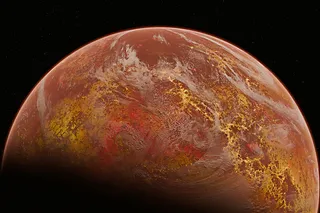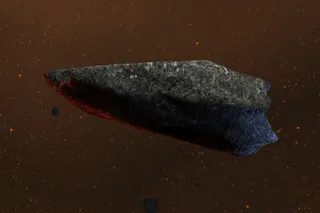


In September 2022, a group of meteorite hunters came across eight stone fragments in the Sahara Desert. These were far from being ordinary stones with an earthly origin, though — that’s because they came straight from Mars.
The eight stones are the fragmented pieces of a rose-colored rock that's believed to have formed more than 4.1 billion years ago on Mars. The rock — which scientists named Teghaza 001 after the Teghaza salt plain in Mali where it was found — is one of the most ancient Martian meteorites identified on Earth.
A new study published in Science has uncovered precisely what makes Teghaza 001 so special: It contains an eclectic combination of igneous (or volcanic) minerals that can provide major clues on Mars’ ancient history — specifically, how its crust formed from cooling magma before being altered by subsurface water.
“It was only after we started looking closely that we realized this meteorite is really unique,” said study lead author Yang Liu of NASA’s Jet Propulsion Laboratory, in a statement. “One of the paper’s reviewers called it a Rosetta Stone for Mars.”
Finding the Ancient Age of Teghaza 001
Over 80,000 meteorites have been found on Earth, according to the University of Colorado Boulder, but only around 435 of them come from Mars.

 Explore All Options
What makes Teghaza 001 even more rare among Martian meteorites is its age — the rock is thought to be more than 4.1 billion years old. The research team involved with the new study confirmed its age with a novel technique called in-situ rubidium-strontium age-dating, using a piece of Teghaza 001 that was smaller than a fingernail and analyzing the minerals on its surface.
This technique revealed that the meteorite had been altered by water sometime around 4.1 billion years ago, meaning it may have formed even earlier.
Read More: Meteorites From the Earliest Planets Reveal How Earth Lost Certain Elements
The Most Ancient Martian Meteorites
Only two other Martian meteorites are this ancient. One is Allan Hills 84001, found in Antarctica in 1984. While this meteorite is similar in age to Teghaza 001, forming around 4.1 billion years ago, it is primarily made of one mineral.
The third ancient Martian meteorite, Northwest Africa 7034 — found in Morocco in 2011 — is the only brecciated Martian sample on Earth, meaning it contains angular fragments of multiple rock types cemented together, according to the Planetary Science Institute. Some of its fragments are aged at 4.48 billion years old.
Teghaza 001 stands apart from the other two meteorites, however, because its igneous minerals match what NASA’s Mars Reconnaissance Orbiter has observed in Mars’ cratered southern highlands.
“This is really our first piece of Martian crust from a part of Mars we’ve never had a sample of before,” said study second author Lee Saper, a scientist at NASA’s Ames Research Center. “It records interactions of water and rock and maybe even an imprint of the Martian atmosphere as it was losing water.”
A Peculiar Mix of Minerals
Previous analysis of Teghaza 001 showed that the meteorite is a shergottite, one of three primary types of Martian meteorites (the others being nakhlites and chassignites). The age of Teghaza 001 makes it unique among shergottites, most of which are surprisingly young, just a few hundred million years old. These younger rocks may result from relatively recent volcanic events rather than remnants of Mars' ancient crust, according to the Natural History Museum in London.
With shergottites being the most common of the three meteorite types — constituting 90 percent of the current Martian meteorite collection, according to a 2025 study in Geochimica et Cosmochimica Acta — Teghaza 001 was not seen as anything special upon first glance.
However, having taken a closer look at Teghaza 001, researchers found odd textures and unusual minerals, including pyroxene, zircon crystals, and iron-titanium oxides. These minerals, the researchers say, could help understand how water and rocks interacted on ancient Mars, forming and altering its crust billions of years ago.
Read More: Ancient Blacksmiths May Have Hammered Away a Meteorite's Cosmic Signature
Article Sources
Our writers at Discovermagazine.com use peer-reviewed studies and high-quality sources for our articles, and our editors review for scientific accuracy and editorial standards. Review the sources used below for this article:
- This article references information from the University of Colorado: Rare meteorite provides evidence of giant early planet
- This article references information from the Planetary Science Institute: Mars Meteorite’s Point of Origin Determined
- This article references information from the Natural History Museum in London: Most Martian meteorites are curiously young in age
- This article references information from a study published in Geochimica et Cosmochimica Acta: Petrology and Geochemistry of Poikilitic Shergottite Northwest Africa 1950: bridging the gap between depleted and intermediate sources in Martian Mantle