An analysis of ancient rock carvings across Europe suggests that Bronze Age communities in the region were better connected than previously thought.
Archaeologists studying Bronze Age peoples can examine long-preserved artifacts or fossils for clues about how people lived thousands of years ago. But other answers can be more directly communicated from the past through petroglyphs, or ancient rock carvings. In Scandinavia alone, more than 20,000 of these carvings depict boats.
In a new study, researchers analyzed boat petroglyphs at 12 locations across two main European regions: Southern Scandinavia (modern-day Denmark and Sweden) and Northwest Iberia (modern-day Portugal and Spain). The research was published in PLOS One.
Read More: Ancient Carvings of Camels Acted as Road Signs to Water in the Desert Around 12,000 Years Ago
Long Distance Cultural and Technological Links
These regions were hard to get between in the Bronze Age, but researchers had previously proposed that a long-distance metal trade, sharing resources like copper and tin, had united the two regions thousands of years earlier.
The new study adds further evidence that the areas had cultural and technological links.
The research team studied the carvings using a high-resolution 3D scanning technology that captures nearly 480,000 measurement points every second. The technology could reproduce the scanned rock with a resolution of 0.05 mm.

 Explore All Options
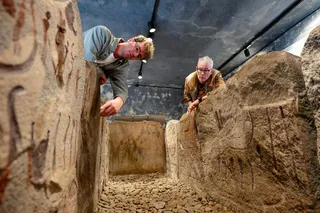
The researchers found that the boats depicted in the two regions shared several design features, including rigging, oars, sail-like shapes, and distinctive end-ship decorations. The Iberian petroglyphs also featured segmented circles, called sun crosses, a distinctive hallmark of solar mythology in the Scandinavian Bronze Age.
Studying Bronze Age Rock Art
The team studied six rock art sites across Iberia: Santo Adrião, Eira do Louvado, Laje da Churra, and Senhora de Encarnação 1 in northern Portugal, as well as Penedo do Muro 1–2 and Laxe Auga dos Cebros 1 in southwest Galicia. Comparing the well-studied rock art in Scandinavia with the newly identified art in Iberia, the team was able to precisely date the latter petroglyphs to around 1300 to 800 B.C.E. This means they were drawn around the same time that maritime technology in Scandinavia advanced.
The team also used a geolocation tool called geographic information systems (GIS) analysis to precisely identify landscape features near the petroglyphs' locations. While some of the carvings were found near the sea, and others far inland, the GIS analysis showed that all of the sites could be accessed from the ocean or via major river systems. This placement mimics the distribution of boat rock art across Scandinavia.
It’s still unclear, according to the authors, whether the petroglyphs were left by Scandinavian sailors far from home or local Iberians who adopted art they had learned from their trading partners, but the carvings are strong evidence of the ancient ties between the areas.
“The enduring images carved into the rocks of northwest Iberia and Scandinavia inscribe the convergence of advanced seafaring technology, crucial economic connectivity, and shared cosmological worldviews across thousands of kilometers, offering a definitive testament to northwest Iberia’s pivotal role in Europe’s early global trade networks,” the authors wrote in their paper.
Read More: 6,000-Year-Old Rock Murals in Texas and Mexico Reveal Ancient Beliefs on the Cosmos
Article Sources
Our writers at Discovermagazine.com use peer-reviewed studies and high-quality sources for our articles, and our editors review for scientific accuracy and editorial standards. Review the sources used below for this article:
- This article references information from a new study published in PLOS One: Boats on the rocks: Late prehistoric nautical iconography and landscape, from Northwest Iberia to Scandinavia