

Twenty thousand years ago, groups of humans were wandering through the wilderness of New Mexico and left behind a trail of footprints.
Now, a study led by an international team of researchers has revealed the vast climatic shifts these early pioneers were witness to: pollen records show sharp and dramatic changes in the landscape, from one covered in pine forests to one of piñon and juniper, all within the space of a century.
"Even though these footprints have been buried in the gypsum mud for more than 20,000 years, they look like someone walked out on the playa yesterday," co-author Jessica Tierney, a professor at the University of Arizona Department of Geosciences, said in a statement.
"This is an incredibly rare opportunity to be able to do paleoclimate reconstruction and combine it with archaeology in the same exact place."
The research has been published in Science Advances.
Read More: Did Researchers Find 21,000-Year-Old Human Footprints in New Mexico?
The Footprints At White Sands
The discovery of footprints at White Sands National Park, in New Mexico, was a major moment in palaeoanthropology, pushing back humans’ arrival in the Americas from 13,500 to 16,000 years ago to 23,500 years ago.
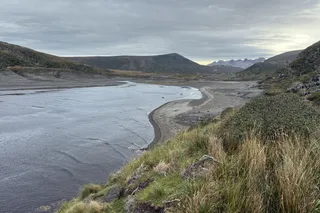
Today, visitors to the park will see a dune field, but when those footprints were formed, it was the site of a prehistoric lake — Lake Otero — that brought mammoths, ground sloths, and other large mammals, including the dire wolf and American Lion, to the area.

 Explore All Options
According to the National Park Service (NPS), researchers have found fossilized footprints in different layers of sediment, showing humans visited the lake over successive generations. Thanks to ancient plant life buried alongside those footprints, researchers have been able to determine when they were formed and, more recently, what conditions were like at the time.
From Pine Forests To Oak Steppe
In this new study, Tierney and colleagues examined individual grains of pollen to produce a more accurate gauge of the age of the footprints. The results suggest the prints were formed during the Last Glacial Maximum, between 23,500 and 21,700 years ago.
With this new chronology, the team was able to combine information from the pollen records with organic molecules left in the sediment to identify climatic and environmental shifts that occurred over generational timescales, or in 20-to-80-year bursts.
They found the area around the lake was originally a mixed conifer forest dominated by pine trees, with an average annual temperature about 10 degrees cooler than today. However, over time, temperatures began to rise, and Lake Otero began to shrink, eventually disappearing entirely and transitioning into a flat playa. This caused the conifer forest to retreat and be replaced by oak and sagebrush.
A Dynamic And Shifting Climate
The data also reveals periods of sudden climatic change, including a short burst of aridity approximately 23,200 years ago, which saw a spike in piñon and juniper pollen and coincided with a rapid warming event in Greenland. In the statement, Tierney explained the transformation from pine to piñon and juniper would have occurred within a span of approximately 100 years.
Meanwhile, the amount of pollen left by an aquatic plant called Ruppia, often found in desert springs, fluctuated. This suggests Lake Otero’s water levels increased and decreased over a 1,500-year period.
Overall, the researchers conclude, it shows the environment around Lake Otero was dynamic.
"It's remarkable that early humans in the region were real-time witnesses to a rapidly changing environment discernible within a human lifetime — that is really food for thought," co-lead Kathleen Springer, USGS research geologist, said in a statement.
"This research continues to remind scientists and the wider public that these resilient ancient human populations are the ancestors of contemporary Indigenous peoples, providing important scientific evidence in support of sovereign Native nations' oral traditions and reinforcing the fact that we have been here since time immemorial," co-author Ed Jolie, Clara Lee Tanner Associate Professor of Anthropology at the University of Arizona, added in the statment.
Moving forward, the team hopes to determine what caused a warming event in Greenland to have such profound climatic effects on the American Southwest.
Read More: White Sands' Footprints Confirmed as the Oldest Evidence of Humans in the Americas
Article Sources
Our writers at Discovermagazine.com use peer-reviewed studies and high-quality sources for our articles, and our editors review for scientific accuracy and editorial standards. Review the sources used below for this article:
- This article references information from a study published in Science Advances: Humans experienced abrupt environmental changes at White Sands during the Last Glacial Maximum
- This article references information from the National Park Service: Fossilized Footprints