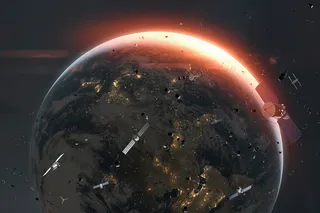


It’s been nearly 60 years since humanity first set foot on the moon, and since then, our quest to explore space has only grown. In 2026 alone, we’ve seen major missions launch, including Artemis II and the Nancy Grace Roman Space Telescope. While these missions will help us explore far beyond what we already know, one issue with the frequency of spacecraft launches is that they leave debris behind in low Earth orbit (LEO).
According to a new study published in the Journal of Applied Physics, nearly one million pieces of debris larger than one centimeter orbit in LEO, and as spacecraft continue to launch, this debris could cause high-speed impacts.
Researchers from Dalian University of Technology in China looked for solutions to this problem and drew inspiration from eggs.
Read More: What Is Space Junk And Why Is It A Problem?
Eggs Inspire a Spacecraft Protective Barrier
Looking at a standard eggshell, one may not necessarily associate it with strength and sturdiness; however, in a collective form, eggs may be better at absorbing and distributing energy.

Water-filled aluminum eggshell array metastructure.
(Image Credit: Wang et al.)
“Natural biological structures have evolved to demonstrate excellent energy absorption performance over long-term adaptation,” study author Yuxin Wang said in a press release.
Inspired by eggs, the team created aluminum “eggshells” filled with water and situated them between two aluminum impact plates. This way, the energy from an impact would disperse through multiple “eggs” instead of one single shell, slowing the energy down. These impacts would also cause each aluminum eggshell to collapse.

 Explore All Options
“A single eggshell breaks easily under local force, but the protection mechanism of the eggshell array is completely different,” Wang said. “The cooperative deformation of these eggshell units transforms the local impact load into distributed energy dissipation across the metastructure, thereby significantly enhancing the anti-impact performance of the target plates.”
According to the new study, adding water inside the aluminum eggs also helps to suppress the impact waves. During a high-impact event, the water inside the egg moves around and absorbs energy as it passes through, slowing it down. Combined with the shape of the aluminum eggshell, these two factors significantly reduce the effects of debris impacts.
Testing Aluminum Eggs
To test this theory, the team ran several simulations, including water-filled aluminum spheres placed between aluminum plates, empty aluminum plates, and then the water-filled aluminum eggs between the two aluminum plates.
The results showed that the water-filled eggs outperformed the other tests. The team noted that the eggs withstood high impacts and even reduced the impact projectile by almost 65 percent. In comparison, the empty aluminum plates reduced the impact projectile by about 51 percent.
The team then tested different water-filled aluminum egg orientations and found that the best overall metastructure pattern was aluminum eggs placed upright, with their small end touching the top of the plate.
This protection method is still far from being equipped on spacecraft. The research team needs to further optimize the method’s geometry, thickness, and filling needs. These optimizations, including refining the aluminum aspect ratio, layout, and thickness, are currently underway, and soon could be ready for future space missions.
“This work demonstrates that bionic, lightweight metastructures are a promising route for hypervelocity-impact protection,” Wang said. “We hope this research can attract more attention to bio-inspired protective structures.”
Read More: How Artificial Moon Dust Helps Us to Build the First Long-Term Lunar Bases
Article Sources
Our writers at Discovermagazine.com use peer-reviewed studies and high-quality sources for our articles, and our editors review for scientific accuracy and editorial standards. Review the sources used below for this article:
- This article references information from a study published in the Journal of Applied Physics: Dynamics analysis on the water-filled aluminum eggshell array metastructure under hypervelocity impact