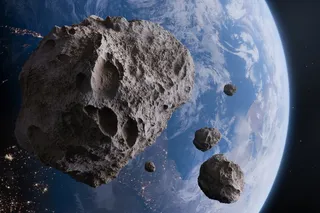
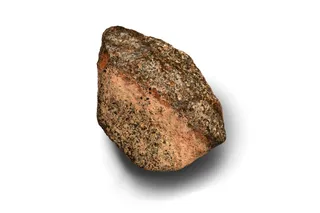
For roughly 100 years, a small asteroid called Kamo'oalewa has been traveling alongside Earth through the Solar System. It is not a moon. It orbits the sun independently, but stays close enough to our path that astronomers classify it as one of only seven known Earth quasi-satellites, objects that shadow our planet through space without ever being captured by its gravity. It is about 100 feet to 330 feet (30 meters to 100 meters) across. Some researchers think it might be a piece of our own moon. On July 2, 2026, for the first time, a spacecraft took its picture from 12 miles (20 kilometers) away.
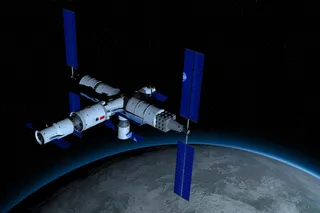
China's Tianwen-2 probe reached Kamo'oalewa, officially designated 2016 HO3, after a 400-day journey covering roughly 620 million miles (1 billion kilometers), Xinhua reported. The China National Space Administration announced the arrival on July 6 and released the first close-up image of the asteroid. The mission, which launched from the Xichang Satellite Launch Center on May 29, 2025, is the first to reach a known Earth quasi-satellite and begins what could be one of the most scientifically unusual sample-return missions attempted.
Read More: The Vera C. Rubin Observatory Recently Spotted Around 11,000 Asteroids — and This Is Just Beginning

 Explore All Options
China’s Tianwen-2 Reaches Earth’s Rare Quasi-Satellite
Tianwen-2 spent more than a year closing in on the asteroid through a series of maneuvers and course corrections. The probe first detected Kamo'oalewa on June 6, 2026, achieved a coplanar flight path alongside it from 18,600 miles (30,000 kilometers) away the following day, and reached about 1,240 miles (2,000 kilometers) on June 19, 2026, China Daily reported. As it approached, the mission team used optical navigation data to reduce the uncertainty in the asteroid's position from hundreds of kilometers down to the kilometer scale.
Kamo'oalewa completes one rotation every 27 to 30.5 minutes, making it a fast spinner, according to a mission overview published in Space Science Reviews. Discovered in 2016 by the Pan-STARRS survey in Hawaii, it was given the Hawaiian name meaning "oscillating celestial fragment."
Its quasi-satellite orbit began roughly 100 years ago and is expected to persist for about 300 more years. The Space Science Reviews paper lists several possible origins, including ejection from the lunar surface after an ancient impact.
How Tianwen-2 Will Collect Samples from Kamo'oalewa
The spacecraft carries 11 scientific instruments, including cameras, spectrometers, and radars, China Daily reported. The mission will move through several observation phases, beginning at about 12 miles (20 kilometers) before closing to 1.9 miles (3 kilometers), about 2,000 feet (600 meters), and approximately 1,000 feet (300 meters), according to the Space Science Reviews paper. Those closer passes will help the team build a map of the asteroid and select a sampling site.
Three sampling approaches have been designed to handle different surface conditions: hovering above the surface to collect particles, briefly touching down with a gas-driven sampling head, and anchoring to the asteroid for harder terrain, according to the mission overview.
A Possible Moon Fragment Traveling Near Earth
After completing its work at Kamo'oalewa over roughly 2.5 years, Tianwen-2 is expected to continue toward 311P, a main-belt comet beyond Mars, according to Xinhua. If successful, it will be the first mission to visit both an asteroid and a main-belt comet, with a total mission duration of roughly a decade.
What it brings back from Kamo'oalewa may matter most of all. If the asteroid is a piece of the moon, its samples would be lunar rock that has been traveling through space alone long before any human ever set foot on our satellite.
Read More: Asteroid 2026 JH2 Is On the Verge of Passing Earth, Only a Few Days After Being Discovered
Article Sources
Our writers at Discovermagazine.com use peer-reviewed studies and high-quality sources for our articles, and our editors review for scientific accuracy and editorial standards. Review the sources used below for this article:
- This article references information from China Daily: Tianwen 2 rendezvouses with target asteroid, set to begin surveys
- This article references information from a study published in Space Science Reviews: Tianwen-2 Mission of China’s Planetary Exploration Program
- This article references information from Xinhua: China's Tianwen-2 probe reaches target asteroid, starts scientific exploration