

Bleached reefs of dead and dying corals are one of the starkest images of how man-made climate change is damaging ecosystems around our planet. A new study in Science Advances shows that scientists can resuscitate dying corals by exposing them to healthy “clone” corals. The findings were conducted in a lab, but provide hope that these vital species could be saved in their natural environment, too.
Coral bleaching happens in response to warming waters, which stresses the corals. Normally, these invertebrates live in a mutually beneficial partnership with algae called zooxanthellae that live in their body tissues. After this stress response is activated, corals eject the algae. Without their partners, the corals then begin to wither and die. The zooxanthellae give corals their bright coloring, which is why dying coral looks so sickly and pale.
But the new story shows that this process isn’t a one-way street.
“While bleached corals may be dying, they are not dead yet,” said Danny Collins, a student oceanographer at Stanford University and co-author of the new study, in a statement. “The question we wanted to answer is, once a coral has bleached, what can we do?”
Read More: Ancient Corals Reveal Today's El Niños Are the Strongest in 1,000 Years

 Explore All Options
Algae Donors to the Rescue

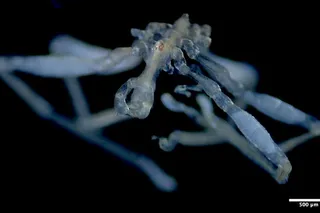
Timelapse of healing corals
(Image Credit: Danny Collins)
Collins had previously studied diseases that affect coral, some of which can transfer through contact with infected plastic debris in the ocean. He wondered: could touch also provide beneficial stimuli to unwell coral?
In their new study, the research team tested whether contact with healthy coral could restore bleached coral fragments. In a tank, Collins arranged pairs of bleached and healthy coral to either touch or be separated by a small distance. Collins found that contact with healthy coral for a week, and in some cases just a few days, was enough to restore bleached coral. Just a week after contact, symbiont algae populations in the bleached coral were doubling every four days. The authors wrote that this rate is roughly ten times faster than most coral recovery times observed in nature. Bleached corals took roughly seven weeks to heal after being separated from their donor clones.
Critically, the team found that this remarkable revival relied on a type of tissue fusion, where tiny channels in the paired corals line up, allowing algae to flow between them. Notably, this healing time was the same in corals that were never separated from their healing partners. This suggests that much of the work happened in the bleached coral, which simply needed a short kickstart from its healthy coral partner.
Getting the Right Match
For this to occur, corals had to be genetically identical clones. Genetically different corals didn’t show the same recovery, and instead appeared to begin a kind of biological war against each other.
“We see something similar in humans. Organ transplants are often successful if the donor is your identical twin,” said Steve Palumbi, an oceanologist at Stanford and co-author of the new study, in the press release.
This requirement means that the approach will likely be hard to scale to address the massive global decline in healthy coral. In recent years, a major coral bleaching event has affected roughly 85 percent of the world’s coral reef area, according to NOAA. The team writes that assessing whether to set up a more universal algae donation program is a critical next step in their research.
Nevertheless, the findings offer hope to coral reefs previously considered beyond saving.
“We hope this new research will inspire solutions that keep corals healthy long enough to enable full recovery after heat waves through slower processes such as growth, reproduction, and recruitment of new colonies,” said Fiorenza Micheli, a marine scientist at Stanford and co-author of the new study, in the press release.
Read More: Coral Reefs Do More Than Build Habitat — They Organize Microbial Life
Article Sources
Our writers at Discovermagazine.com use peer-reviewed studies and high-quality sources for our articles, and our editors review for scientific accuracy and editorial standards. Review the sources used below for this article:
- This article references information from a study published in Science Advances: Rapid coral bleaching recovery via symbiont transfer from healthy corals
- This article references information from NOAA: Current Global Bleaching: Status Update & Data Submission