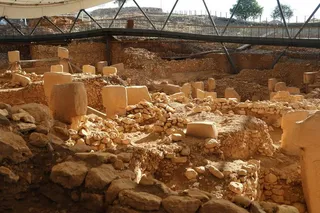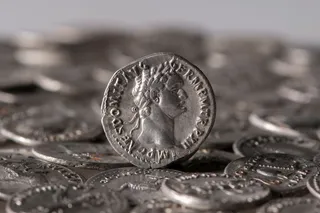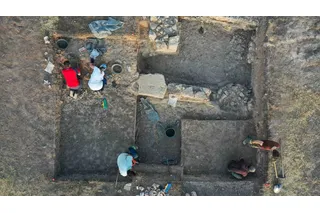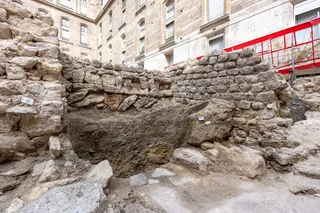


In the summer of 2014, the Syrian Civil War was at its peak. Amid the fighting and destruction, a team of archaeologists carried out a perilous task: rescuing tens of thousands of historical artifacts from the now permanently closed Deir ez-Zor Museum in northeastern Syria. Between 2014 and 2015, a total of approximately 30,000 items were saved from possible ruin.
In a new paper published in the journal Museum Management and Curatorship, Professor Abdulkarim, then director-general of the Directorate-General of Antiquities and Museums (DGAM), provides an account of the mission.
“We did not rescue 30,000 museum objects simply to save 30,000 objects,” Abdulkarim, now professor of archaeology and history at the University of Sharjah, UAE, told Discover. “We were protecting thousands of years of the memory of the Euphrates region, at a time when its communities themselves were suffering enormous human losses because of the war.”
Syria’s Rich and Ancient History

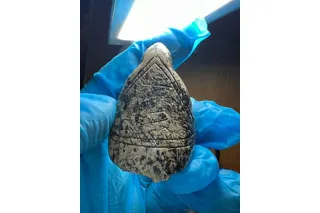
An agate beads necklace from Tell Terqa, dating to the second millennium B.C.E.
(Image Courtesy of Yaarob Abdullah)
Syria has a rich and diverse cultural history. As part of the Fertile Crescent, it was home to some of the world’s first human civilizations and some of the earliest known agriculture. Over the millennia, it has seen the arrival and departure of countless more cultures, from the Egyptians and Hittites to the Byzantines and Ottomans.

 Explore All Options
More recently, the country has been subjected to an intense civil war and the destruction that accompanies conflict.
In addition to the tremendous human cost, war can pose a catastrophic risk to a region’s history and archaeology. In some cases, heritage sites are deliberately demolished; other times, the damage is collateral, and sometimes historical artifacts are plundered and exploited for financial gain.
It was the raiding of the Mosul Cultural Museum in Iraq in 2014 that highlighted the urgency of the situation in northeastern Syria and the need to act decisively to save the museum’s treasures.
“For me, Mosul was a clear warning that waiting for ideal security conditions was no longer possible,” said Abdulkarim. “The greater risk could be doing nothing.”
Read More: Newly Discovered Saqqara Tombs Preserve a 3,000-Year-Old Family Record
Phase 1: The Summer of 2014

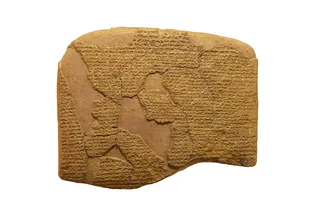
New-Assyrian cuneiform tablet from Tell Sheikh Hamad, first millennium B.C.E.
(Image Courtesy of Yaarob Abdullah)
By the summer of 2014, access to the Deir ez-Zor was restricted to a very thin, very vulnerable corridor linking a portion of the city to a military airport.
Despite facing deteriorating levels of security and limited resources, museum personnel and DGAM staff moved more than 11,000 artifacts, representing some of the museum’s most significant holdings, to the airport, where they were then flown to Syria’s capital, Damascus, by transport aircraft. Here, they were placed in secure storage facilities, and another major effort began: redocumentation and conservation.
“Digital documentation became a central element of our heritage protection strategy during the war,” said Abdulkarim, explaining that it offers a second layer of protection.
“It helps establish an object’s identity, trace and potentially recover it, and combat theft and illicit trafficking if it is lost,” he added.
Phase 2: The Summer of 2015
In 2015, there was another major crisis: key archaeological sites were destroyed, including a UNESCO World Heritage Site in central Syria. This included the Temple of Ba’al Shamin, which UNESCO described as one of the most important religious buildings of its time and place.
In response, the DGAM decided to evacuate all artifacts housed in museums in conflict zones, including Deir ez-Zor. This led to another batch of artifacts being relocated to Damascus, bringing the combined total over the two years to almost 30,000.
“My judgment was that the risks of leaving the collection in Deir ez-Zor had become greater than the risks of moving it,” said Abdulkarim.
Protecting Culturally Significant Items

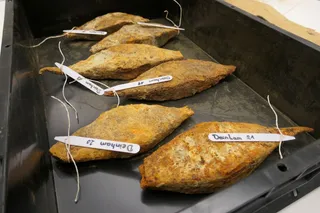
People packing and documenting items.
(Image Courtesy of Ahmed Deeb)
Protecting items of cultural significance during periods of war and conflict does not come without considerable risk. The head of antiquities in Palmyra was publicly executed for refusing to disclose the location of hidden artifacts.
Fortunately, none of Abdulkarim’s colleagues were injured during the two evacuation missions, but he explained the risks were real and the most difficult aspect for him personally.
Teams also face significant constraints, from limited resources to time pressure. In the paper, Abdulkarim describes the flexibility of the individuals involved in the mission, from packaging items in wooden crates, cotton canvas, and reinforced cardboard when specialized materials were unavailable to using paper inventories when real-time digital databases were not an option.
“In wartime, heritage cannot be protected through a rigid plan,” said Abdulkarim. “Responsibility does not mean waiting for a risk-free decision, because such a decision may not exist. It means continuously reading the situation, weighing the risks, and acting before the opportunity disappears.”
Read More: When People Vandalize Art, Conservators Come to the Rescue
Article Sources
Our writers at Discovermagazine.com use peer-reviewed studies and high-quality sources for our articles, and our editors review for scientific accuracy and editorial standards. Review the sources used below for this article:
- This article references information from a study published in Museum Management and Curatorship: The rescue of the Deir ez-Zor museum collections during the Syrian conflict: cultural emergency management, multi-level governance, and lessons for heritage protection
- This article references information from UNESCO: Site of Palmyra