What does it take to make a student who gets nervous talking to professors run straight to one? For Brooklyn Rolph, it was a stone spear point, shaped thousands of years ago, lying at the edge of a Virginia inlet.
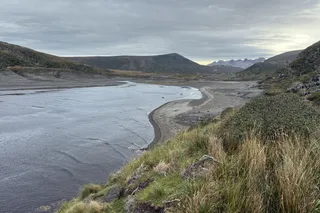
The point turned up in September on a barrier island off Virginia’s Eastern Shore, where Rolph, a biology student at Mary Baldwin University, was looking for shark teeth during a state-permitted ecology field trip, and because the state owns the island, the point now belongs to Virginia and is being studied by archaeologists.
She says four days in the field with her professors, including a morning of wading through a seagrass bed in wetsuits, helped her see them as people, and on the day of the find she says they were even more excited than she was.
“They were ecstatic,” Rolph said in a press release. “I think they were happier than I am.”
Professor Paul Callo, who helped lead the trip, said he was “truly at a loss for words” once she showed him the point.
“It is certainly awe-inspiring to see and touch something that was made by human hands thousands of years ago,” he said. “Brooklyn was probably the first person to see it and touch it in all of that time.”

 Explore All Options
Finding a Spear Point on Virginia’s Eastern Shore

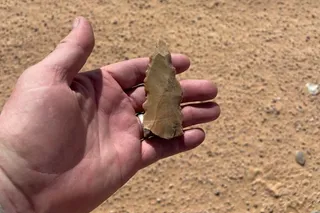
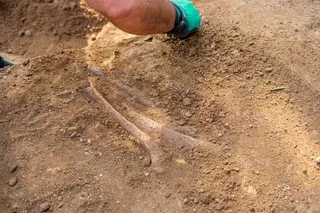
Recently discovered stone spear.
(Image Courtesy of Mary Baldwin University)
The find nearly did not happen, since wind left the class unsure the boats could go out at all, and once they did, the tide and currents limited the stop to 35 to 40 minutes, leaving students just a few minutes to explore after lunch.
Shells were everywhere on the island, and since Rolph had found small shark teeth on a beach once before, she hoped to turn up more.
“I already have the field of view that I’m looking for something pointy,” she said.
When the point caught her eye along the inlet’s edge, her next move was to go straight to Adam Seroka, one of the professors who led the trip.
“And then I pick it up, and I literally sprint to Dr. Seroka,” she said in the press release.
What Is the Spear Point and Where Is It Now?
Callo said his first words when he saw it were not a full sentence.
“I think I said, ‘What the … what the …,’” he said, before adding, “No f-bomb!”
State archaeologists identified the point as a Lehigh/Koens-Crispin point, a style of spear tip, and the university estimates it is 3,000 to 4,500 years old. It measures about 6 inches, and the archaeologist who looked it over had not seen another so well preserved.
Callo had warned her she might have to give it up, and a phone call from the site director confirmed that the state owned it, so state conservation staff collected it that day for the Department of Historic Resources.
How the Ecology Field Trip Changed the Students
The biology department runs the trip every year so ecology students can see how coastal animals, plants, and their surroundings connect in person.
Each student on the trip ran an experiment of their own, and Rolph’s tested how fast oysters and sea squirts, which feed by filtering water, clear cloudiness out of water, and running one by herself was not something she had done before.
The days in the field also changed how the class got along, turning a group that had started out unsocial into one where everyone was chit-chatting.
Medicine had been her plan, and she still calls herself “a cell biology person,” but the fieldwork gave her something new to consider.
“It made me realize that I enjoy research and I enjoy the fieldwork,” she said in the press release.
Read More: 1,500 Animal Remains and Tools Suggest Neanderthals Returned to This Spanish Cave for Generations
Article Sources
Our writers at Discovermagazine.com use peer-reviewed studies and high-quality sources for our articles, and our editors review for scientific accuracy and editorial standards. Review the sources used below for this article:
- This article references information from Mary Baldwin University: Biology Student Finds Ancient Spear Point on Eastern Shore Field Trip