

Two years ago, Earth was struck by a large geomagnetic storm that scrambled satellites and forced transatlantic flights to change course. The event disrupted GPS systems, impacting the food industry and costing U.S. agriculture half a billion dollars.
While it is a more intense example, it is not an outlier. Geomagnetic storms — even extreme ones — are a relatively regular occurrence. At their best, they can trigger the spectacular aurora borealis. At their worst, they can fry satellites, trigger power outages, and cause havoc.
Now, researchers are asking how we can fortify Earth against its most severe side effects. In a paper published in the journal Space Weather, the authors describe a system named “StormWall,” which involves flinging chemicals into the outer edges of the planet’s geomagnetic field in order to provide a temporary shield that deflects extreme space weather.
“People have always thought, ‘space is huge, the sun is massive, we just have to sit here and take whatever it gives us,’” Brian Walsh, an associate professor of mechanical engineering at Boston University’s College of Engineering, explained in a statement.
“But what we found is that we can impact it.”
Read More: NASA and ESA Track Record-Breaking 19-Day Solar Radio Burst

 Explore All Options
Fortifying Earth with a “StormWall”
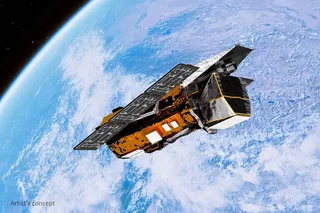
According to the paper, the system works as follows: Six spacecraft would be launched into orbit around Earth at a speed that perfectly matches the planet’s rotation. Each of these carries a canister containing certain Earth metals (such as barium or lithium) that become electrically charged when released and exposed to sunlight. This produces plasma that drifts toward the edge of the geomagnetic field facing the sun. A plasma cloud then forms a barrier that deflects incoming space weather and prevents a significant portion from reaching Earth.
The team tested their system with simulations based on the 2024 “Gannon” storm, chosen because it is the largest storm for which upstream solar wind measurements are available. According to their calculations, it may be possible to reduce the storm's intensity by 50 percent or more.
Walsh explained the substances released into space would then leave the system, drifting out on natural highways — “the magnetosphere flushes the material out within six or so hours,” he said.
Is “StormWall” Worth the Cost?
One hurdle to implementing a plan such as this is one of cost. The process is expensive and very much a one-and-done situation. While Walsh believes it is possible to reduce overall costs, he also points to the expense of inaction.
The 2024 storm was a one-in-20-year storm. A one-in-100-year storm would be far more extreme, potentially causing widespread damage to electrical systems and power grids, and costing trillions of dollars, according to a report from the European Geosciences Union.
One of these extreme events took place in 1859. According to NOAA, the storm sent powerful electrical currents down telegraph machine wires, shocking operators and igniting office fires. It even led to nonsensical messages sent by no one. But this was before an interconnected world, linked by satellite systems and power grids, where a similarly severe storm could cause power outages and radio blackouts that could interfere with everything from financial transactions to travel to security.
More recently, there have been cases where solar storms triggered sea mines off the Vietnamese coast and caused U.S. military detection devices to falsely report a nuclear bomb had been detonated.
Walsh believes StormWall has the potential to benefit all.
“If you built it, if it was deployed, it would help all people on the planet,” he said. “You couldn’t make it in a way that helped only one country, one group of satellites.”
Read More: Orbiter Observes Sun's Hot Spots for Record-Breaking 94 Days, Enhancing Solar Storm Forecasts
Article Sources
Our writers at Discovermagazine.com use peer-reviewed studies and high-quality sources for our articles, and our editors review for scientific accuracy and editorial standards. Review the sources used below for this article:
- This article references information from a study published in Space Weather: Terrestrial Space Weather Protection Through Human-Produced Mass-Loading
- This article references information from NASA: What NASA Is Learning from the Biggest Geomagnetic Storm in 20 Years
- This article references information from NOAA: Five historically huge solar storms
- This article references information from the European Geosciences Union: How severe space weather can disrupt global supply chains