Someone in Roman-era Asia Minor, in what is now Turkey, throws five knucklebones to ask the gods whether the time is right to act. The answer might tell them to go ahead, but many of the messages carved into a local oracle stone tell them to stop rushing and wait.
A new study in Gephyra, by Turkish researchers, describes one such stone, found in 2024 in a chapel wall at the ancient city of Kibyra, and says it shows the city took part in a knucklebone oracle tradition shared across southern Asia Minor.
The replies run from promises that the sick will recover to a bleak reply for one particular throw, which reads in the authors’ translation, “The sun has set, and deadly night has come upon us,” and advises that it is better “neither to buy nor to sell."
How the Knucklebone Oracle Worked
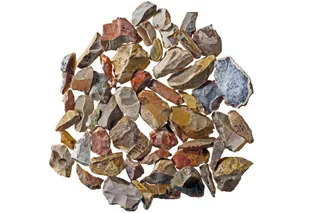
A knucklebone, or astragalus, is a small joint bone from the hind legs of sheep, goats, and calves, and ancient people often used them as dice. Each bone lands on one of four faces, valued at 1, 3, 4, or 6.
Someone seeking advice from the oracle, a way of asking the gods questions, threw five bones and matched the combination of face values to one of 56 possible answers carved in stone, each a short reply in Greek verse. That bleak reply belongs to the throw where all five bones land on the face valued at 4.

 Explore All Options
The Kibyra pillar stands about 4 feet tall and is carved on every side. The researchers date it to the second or third century C.E. and say it was most likely moved into the chapel wall as building stone from the city’s agora, or marketplace. Among the other surviving replies, one says “it is not yet the time,” and another warns “Do not put your hand into the mouth of a wolf.”
Read More: Ancient Bronze Ring Engraved with Alexandria’s Famous Lighthouse Found in Sunken Royal Ruins
Why Towns Built Oracles for Everyday Questions
The region had no large, famous oracle centers of its own in this period, the researchers note. Cities sometimes sent people to Klaros or Didyma to ask on the town’s behalf, but pillars like this one answered everyday troubles like illness, trade, travel, and losses. Earlier scholars suggest merchants were the main audience and that the idea may have spread from town to town as a fashion.
At Kibyra, a partly lost dedication on the stone says that someone paid for the oracle and for a statue of the god Hermes, with its base and decorations, all at their own expense. In myth, Apollo kept real prophecy for himself and handed the smaller craft of divining with dice to Hermes. The donor’s name was probably on the upper block, which has not been found. The researchers say the donor may have been a market official, as at a similar pillar in the city of Termessos.
Carving Errors and Hopeful Answers
Stones in other towns across the region carried versions of much the same set of answers, and scholars have used them to reconstruct the shared original. Next to those copies, the Kibyra text is closest to the one from Kremna, another city in the region, though it has slips of its own.
Measured against the reconstructed original, the researchers blame careless stonemasons or local editing for grammatical mistakes and lines that break the poem’s rhythm. In one answer, two words are swapped and a phrase is missing. Another reply sits at a different position than in other copies, which they take as a sign that Kibyra had its own editors.
Many replies are hopeful, though, with one promising that “the gods will bring the one who is far away safe and sound back to their home.” For someone who could not make the long trip to a famous sanctuary, a stone like this one kept an answer close to home.
Read More: A Medieval Hunter May Have Turned a 220-Pound Wild Boar's Tusk Into a Lucky Charm
Article Sources
Our writers at Discovermagazine.com use peer-reviewed studies and high-quality sources for our articles, and our editors review for scientific accuracy and editorial standards. Review the sources used below for this article:
- This article references information from a study published in Gephyra: A New Astragalos Oracle Text from Kibyra: A Comparative Study with Southern Asia Minor Parallels