

Sharing a neighborhood with T. rex sounds stressful enough without having to compete for dinner. For one small, feathered dinosaur, finding a meal may have meant looking for something squishy and ripe.
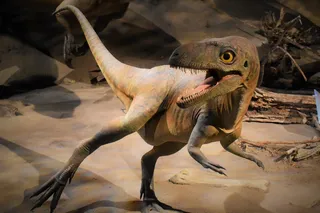
About the size of a turkey, Infernogallus jamesi had a toothless beak and an unexpected set of tools inside its skull. Its jaw appears to have been built for working soft fruit away from a hard central seed — a surprisingly particular dining habit for an animal descended from meat-eating dinosaurs.
Now, a rare fossil is helping scientists reconstruct that prehistoric menu. Research published in Nature Communications suggests the newly described species was adapted for eating fruit, offering a glimpse of an ecological role that has been difficult to recognize in dinosaur fossils.
“We knew dinosaurs evolved to fill so many different roles in ecosystems in the Cretaceous, but we never expected to discover fruit-eating dinosaurs,” said lead researcher Gregory Funston in a press release. “For more than 100 years, we didn’t know what the skulls of these animals looked like. Now, we know they were even weirder than we could have predicted.”
Meet Infernogallus, the Fruit-Eating “Hell Chicken”
The name Infernogallus means “hell chicken,” a reference to the Hell Creek Formation in the United States, where its remains were discovered. This was also home to T. rex and Triceratops, although the approximately 25-pound newcomer would have been easy to overlook beside those famous neighbors.

 Explore All Options

Skeletal reconstruction of Infernogallus jamesi.
(Image Credit: © Royal Ontario Museum)
It belonged to the caenagnathids, a group of toothless, feathered dinosaurs within the oviraptorosaurs. Even as adults, Infernogallus was among the smallest members of its group.
Its fossil, however, was a big discovery — a nearly complete skull with its bones still connected, alongside a partial skeleton. Small dinosaur remains this complete are uncommon, making the specimen particularly useful for investigating how the animal fed.
“Complete remains of small dinosaurs like Infernogallus are very rare in the fossil record. The strange skull of Infernogallus is an exciting find because it reveals surprising insights into dinosaur evolution and feeding specialization. This discovery shows that we still have a lot to learn about the world of T. rex, and about dinosaurs more generally,” said David Evans, chief curator at the ROM.
Read More: Newly Identified Norellraptor Could Reshape What We Know About Feathered Dinosaur Flight Evolution
How This Unusual Dinosaur Processed Fruit
The clues to its eating habits were tucked neatly into the roof of its mouth.
Using CT scans to reconstruct the skull, researchers examined the palatal bones and inferred how the chewing muscles would have worked. These bones curved downward into the mouth, changing the orientation of certain muscles so they pulled from front to back.
That arrangement would’ve allowed the lower jaw to slide backward and forward, helping mash food between opposing surfaces, similar to how humans chew.
The researchers recognized a comparable arrangement in living fruit-eating parrots, including the Vulturine Parrot. That resemblance supports the interpretation that Infernogallus processed soft plant foods in its mouth rather than its gut.
“It’s pretty rare for animals to become specialized for a diet of fruit, so when it happens, it comes with some remarkable adaptations. The anatomy of Infernogallus is bizarre among dinosaurs, and we quickly realized that we were dealing with something special,” explained study co-author Thomas Dudgeon.
What Fruit-Eating Dinosaurs Reveal About Ancient Ecosystems
The discovery also raises a bigger question: Could dinosaurs have helped shape the plants around them?
During the Cretaceous, flowering plants spread and diversified, while fleshy fruits became larger and more widespread. The researchers suggest that specialized feeding adaptations in caenagnathids developed alongside those changes.
Fruit-eating animals today can transport seeds, helping plants spread. Dinosaurs may have performed a similar service, although whether Infernogallus dispersed seeds remains an open question.
That possibility gives this little dinosaur significance beyond its unusual diet. Understanding an ancient ecosystem means accounting for the animals processing fruit and potentially moving seeds, alongside the giants dominating museum halls.
Read More: Small Dinosaurs May Have Had an Evolutionary Advantage Over Their Enormous Relatives
Article Sources
Our writers at Discovermagazine.com use peer-reviewed studies and high-quality sources for our articles, and our editors review for scientific accuracy and editorial standards. Review the sources used below for this article:
- This article references information from a study published in Nature Communications: Fruit-eating adaptations in a Late Cretaceous oviraptorosaur (Theropoda)