

Some spectacles in the universe are so enormous that their existence flat out baffles scientists. Prodigious superstructures like the Big Ring, an assembly of galaxies and galaxy clusters that boasts a circumference of about 4 billion light-years, may throw a wrench into the standard model of cosmology that astrophysicists have been trying to decipher for years.
The Big Ring was discovered in 2024 and first explained in the Journal of Cosmology and Astroparticle Physics. Located 9.2 billion light-years from Earth, the structure, unsurprisingly, appears as an almost perfect ring near the constellation Boötes.
According to a statement from the University of Lancashire, if we were able to see it directly in the sky, the Big Ring’s diameter would need about 15 full moons to cover it. Its unfathomable size is what makes it so curious — scientists don’t even fully know why the Big Ring can exist in our universe.
Revealing the Big Ring
Although the Big Ring appears as if it were an entire ring, in reality it’s more like a coil that faces Earth. Researchers found the Big Ring by examining quasars, the bright cores of galaxies that are powered by supermassive black holes. These quasars served as a backlight, revealing even more distant, fainter galaxies that make up the Big Ring.

 Explore All Options
The same researcher who discovered the Big Ring — Alexia Lopez, who is now a postdoctoral researcher at the University of Lancashire (formerly the University of Central Lancashire) — had already struck cosmic gold back in 2021 when she found a separate superstructure called the Giant Arc.
While the Big Ring is formidable at 1.3 billion light-years across, the Giant Arc vastly eclipses it, spanning 3.3 billion light-years across. The two structures are close neighbors, located at the same distance and at the same cosmic time. They’re also only 12 degrees apart in the sky, according to the University of Lancashire.
Read More: Giant Galaxies Emerged Just 1.4 Billion Years After the Big Bang
Challenging the Standard Model
Superstructures like the Big Ring and the Giant Arc pose critical questions for scientists, all because of a disagreement with the standard model of cosmology.
The standard model — the very framework that holds up the origins and composition of the universe — operates under a crucial assumption: Beyond the concept that the universe is both homogeneous (the same everywhere) and isotropic (the same in all directions), the cosmological principle says that any galactic structure larger than 1.2 billion light-years is theoretically impossible, according to the University of Lancashire.
This is why the Big Ring is such a head-scratcher — it far exceeds this theoretical size limit. The standard model asserts that the universe simply isn’t capable of building such large structures due to limitations involving its age and gravity.
Scientists have a few potential explanations for why the Big Ring and Giant Arc are able to exist. The structures could have something to do with Baryonic Acoustic Oscillations (BAOs), which are remnants of sound waves that once rippled through the primordial universe, but researchers say the Big Ring is too large and not spherical, as one would expect of BAOs.
Another explanation is linked to cosmic strings, which are theoretical one-dimensional objects that may have formed shortly after the Big Bang, according to EBSCO. The strings may explain the structure of the universe, even when it comes to the superstructures that seem improbable under the standard model.
Superstructures Galore
To complicate matters even more, the Big Ring and the Giant Arc aren't the only superstructures in the universe.
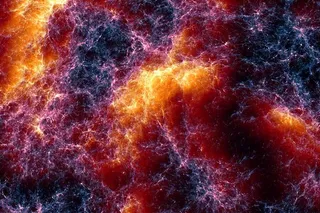
Numerous additional superstructures exist, including Quipu, a collection of 68 galaxy clusters that was discovered in 2025. According to the Max Planck Society, researchers named the superstructure Quipu as a nod to the Incan record-keeping device of the same name, which uses bundles of strings with knots. The Quipu structure, the researchers say, has a similar shape with side strands woven into it.
The arXiv preprint paper on the 2025 discovery explains that Quipu and four other superstructures (Shapley, Serpens-Corona Borealis, Hercules, and Sculptor-Pegasus) contain about 45 percent of galaxy clusters, 30 percent of galaxies, and 25 percent of matter in the entire universe.
The Big Ring and its fellow superstructures ultimately continue to confound scientists, who are still trying to understand what they mean for our understanding of the universe.
Read More: NASA’s Colorful Cosmic Map Could Shed Light on First Moments After Big Bang
Article Sources
Our writers at Discovermagazine.com use peer-reviewed studies and high-quality sources for our articles, and our editors review for scientific accuracy and editorial standards. Review the sources used below for this article:
- This article references information from a study published in the Journal of Cosmology and Astroparticle Physics: A Big Ring on the sky
- This article references information from EBSCO: Cosmic strings
- This article references information from a preprint study published in arXiv: Unveiling the largest structures in the nearby Universe: Discovery of the Quipu superstructure
- This article references information from the Max Planck Society: Largest superstructure in the nearby universe discovered