The people who marked a lightning strike at Hadrian’s Villa carved two words into a marble slab. Their inscription, FVLGVR SVBMANIVM, identified the bolt as the work of Summanus, the Roman god associated with lightning at night. For them, the strike meant a god had intervened, making the ground it touched sacred.
Archaeologists have now found that slab still attached to a small stone structure at the imperial residence in Tivoli, Italy. The discovery provides evidence of how Romans responded to a lightning strike through ritual and may help explain changes to this part of the villa.
"This discovery shifts attention from grand architecture to the more intimate sphere of Roman religiosity,” said Alberto Samonà, director of the Institute of Hadrian's Villa and Villa d'Este, in a translated press release.
A Lightning Inscription at Hadrian’s Villa
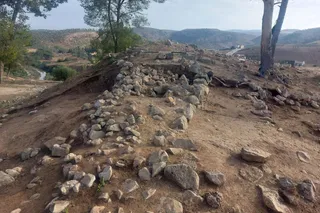
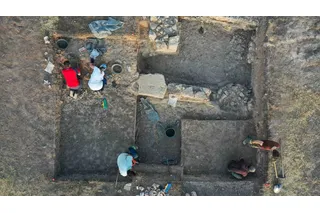
The University of Urbino team, led by excavation director Fabio Giorgio Cavallero, uncovered the structure between the area known as the Amphitheater and a stretch of exposed volcanic rock. Built from tuff blocks held together with mortar, it has four sides and a marble slab measuring about 16 by 14 inches (40 by 35 centimeters) fitted into its front.
The inscription’s two lines of capital letters remain fully readable. Its reference to Summanus reflects a distinction Romans made between nighttime lightning and daytime bolts, which they attributed to Jupiter.

 Explore All Options
Archaeologists think the structure may have marked or enclosed a bidental, the sacred area associated with a lightning strike. Because the inscription remains in its original position, the team can investigate its relationship to the surrounding buildings.
Read More: Nearly 4 Million Coins Show How Rome Built an Economy Across Its Conquered Territories
Why Romans Buried the Traces of Lightning
The Roman response involved gathering material affected by the strike and burying it, with sacrifices and specific words spoken during the ceremony. The expression fulgur conditum refers to this ritual burial of lightning.
The ministry also points to evidence of the ritual at Bagno Grande in San Casciano dei Bagni, another archaeological site in Italy. There, researchers found a bronze object shaped like a lightning bolt deposited alongside a flint arrow.
Another discovery in Rome shows what such a burial could entail. In 1864, researchers found a gilded bronze statue of Hercules beneath a palace courtyard, lying in a trench under a stone slab. The slab bore the letters F C S, short for Fulgur Conditum Summanium. According to the Vatican Museums, lightning struck the statue, and it was ritually buried alongside the remains of a lamb.
How a Sacred Spot Could Change the Villa
In 2024, archaeologists uncovered a palace in the Amphitheater area that had been torn down and its remains buried. Cavallero’s team will study the archaeological layers to determine when the lightning ritual took place in relation to the demolition and burial.
“The discovery opens new perspectives on the history of this sector of Hadrian’s Villa and on the role of the fulgur conditum ritual in the reorganization of the spaces,” Cavallero said in the translated press release.
Read More: A Mummified Dog and Stacked Bodies Reveal a Crowded Egyptian Tomb’s Hidden Order
Article Sources
Our writers at Discovermagazine.com use peer-reviewed studies and high-quality sources for our articles, and our editors review for scientific accuracy and editorial standards. Review the sources used below for this article:
- This article references information from Italy’s Ministry of Culture: In Hadrian's Villa, in the Amphitheatre area, evidence of the fulgur conditum resurfaces, the ancient Roman rite that consecrated places struck by lightning.
- This article references information from the Vatican Museum: Hercules Mastai