

The Atlantic Meridional Overturning Circulation (AMOC) may be weakening at a much faster rate than previously thought, with new research predicting a slowdown of more than 50 percent by the end of the century.
This could move us closer to a dangerous tipping point that could trigger a cascade of environmental changes, from severe cold snaps in Europe to droughts in the Sahel and extreme weather events.
By incorporating observational constraints, researchers writing in Science Advances have attempted to reduce the uncertainty inherent in most models to date and produce a more realistic projection of AMOC weakening.
What is the AMOC?
AMOC, or Atlantic Meridional Overturning Circulation, is a vast system of ocean currents transporting water across the world, a little like a conveyor belt or the Interstate Highway System. Warm, salty water moves north along surface-level currents, bringing milder climates to northern Europe, before cooling, sinking, and returning south along deep water currents.
While there is a general consensus that AMOC will likely weaken this century, there is debate and uncertainty about exactly how much it will weaken and over what time frame, with different climate models producing wildly different predictions.
Read More: Around 12,900 Years Ago, a Cluster of Volcanic Eruptions May Have Triggered a Sudden Ice Age

 Explore All Options
Reducing Levels Of Uncertainty
According to the paper’s authors, the lion’s share of this uncertainty can be attributed to the climate models themselves. In an attempt to reduce uncertainty, the team trialed four observational-constraint methods that combined CM1P6 climate models with real-world observations of at least one directly measurable variable.
Of the four methods, the ridge-regularized linear model approach appeared to be the most effective, reducing inter-model spread by 79 percent and allowing the researchers to consider 19 variables.
According to its estimates, AMOC will be approximately 51 percent weaker by 2100 than its average between 1850 and 1900 — a result that would be considered a “substantial weakening of the AMOC” by the Intergovernmental Panel on Climate Change (IPCC). It is also around 60 percent higher than the mean predictions of the climate models.
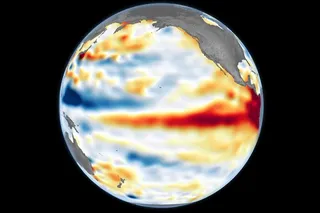
The researchers highlight two variables in particular: sea surface temperatures in the subtropical region and sea surface salinity in the South Atlantic. Both temperature and salinity affect the buoyancy and density of water and, in turn, influence deep-water formation.
The paper’s authors ascribe improvements in the model’s certainty to “correcting a bias in South Atlantic surface salinity.” But while they note improvements, the researchers also note that other variables — such as the melting of the Greenland Ice Sheet — are not included in the climate models and could influence predictions.
Relying on Climate Models
Jochem Marotzke, Director at the Max Planck Institute for Meteorology, who was not involved in the research, described the study as thorough and well done:
“This study illustrates one point very clearly: A more realistic, higher surface salinity in the South Atlantic leads to a greater weakening of the AMOC. I can well imagine that this relationship will hold true also for superior models of the future.”
But Marotzke also explained that the researchers have no option but to rely on climate models that struggle to properly simulate AMOC fluid dynamics.
“Whether the reduction in model spread described in the paper truly reduces the actual uncertainty remains open,” Marotzke told Discover. “We are far from having a reliable understanding of the fundamentals of AMOC variability and change.”
“We must move away from the current unrealistic ocean dynamics in most climate models and simulate the ocean in its true, turbulent nature, as part of climate simulations,” Marotzke added.
What Would A Weakening Of The AMOC Mean In Practice?
The AMOC plays a key role in regulating climate, bringing warm water and a milder climate to parts of western Europe on the same latitude as Canada. A weakening — or, in a worst-case scenario, a collapse — of the AMOC could cause temperatures in Europe to tumble. According to a 2024 study in Science Advances, in modeled collapse scenarios, the continent could experience “very strong and rapid cooling” of more than 5.4°F (3°C) per decade.
More generally, it could alter rainfall patterns and storm activity worldwide and increase the frequency of extreme weather events, according to the National Oceanography Center, U.K.
Read More: About 34 Million Years Ago, Earth’s Most Powerful Ocean Current Emerged and Reshaped the Climate
Article Sources
Our writers at Discovermagazine.com use peer-reviewed studies and high-quality sources for our articles, and our editors review for scientific accuracy and editorial standards. Review the sources used below for this article:
- This article references information from a study published in Science Advances: Observational constraints project a ~50% AMOC weakening by the end of this century
- This article references information from a study published in Science Advances: Physics-based early warning signal shows that AMOC is on tipping course
- This article references information from the National Oceanography Center, U.K.: Understanding the Atlantic Meridional Overturning Circulation