As earthquake vibrations travel upward through the Great Pyramid of Giza, they intensify before weakening inside chambers constructed above the King’s Chamber. That drop in vibration strength may be one reason the pyramid has survived thousands of years of earthquakes with relatively little damage.
A new study, published in Scientific Reports, examines why the Pyramid of Khufu has endured centuries of seismic activity, including an 1847 earthquake estimated at magnitude 6.8 and the 1992 Cairo earthquake, which killed more than 500 people, without suffering serious internal or external damage.
Researchers found that seismic energy moves through the pyramid differently than it does through the surrounding ground, helping distribute stress through much of the structure instead of concentrating it in one area.
The structure, completed more than 4,500 years ago, contains an estimated 2.3 million limestone blocks and originally stood nearly 482 feet (147 meters) tall. But despite its immense weight and scale, seismic energy appears to move through the pyramid in unusually controlled ways.
Read More: Are the Egyptian Pyramids Aligned with the Stars?
Why the Great Pyramid of Giza and the Ground Beneath It Respond Differently to Earthquakes
Researchers used sensitive vibration sensors to record ambient tremors at 37 locations throughout the pyramid, including internal chambers, passageways, outer stones, and surrounding soil. The tiny vibrations came from sources such as ocean waves, climate activity, and human movement.

 Explore All Options
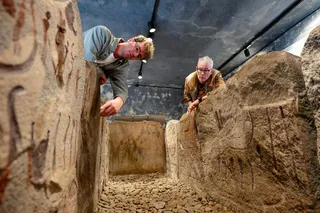
Some of the pyramid’s narrow upper chambers were so cramped that researchers had to carefully position instruments inside the stone spaces above the King’s Chamber.
Most areas inside the pyramid shared nearly identical vibration frequencies ranging from 2.0 to 2.6 hertz. The surrounding ground, however, vibrated much more slowly at roughly 0.6 hertz. That mismatch may help protect the structure during earthquakes.
When structures and the ground beneath them move in sync during an earthquake, shaking can become amplified. But the Great Pyramid and the surrounding soil move at different rates, potentially limiting how much earthquake energy is transferred into the structure itself.
The King’s Chamber May Have Its Own Seismic Buffer
The study also tracked how vibration levels changed at different heights inside the pyramid.
Near the bedrock, amplification remained low. Higher up, however, vibrations became steadily stronger, peaking inside the King’s Chamber at roughly four times the vibration level measured at the pyramid’s foundation.
That made the King’s Chamber one of the most seismically amplified spaces measured inside the pyramid.
Despite sitting even higher in the structure, a series of narrow chambers built above the King’s Chamber recorded lower amplification levels than the room beneath them. Those spaces, often called relieving chambers, were originally designed to reduce pressure from the stone blocks above.
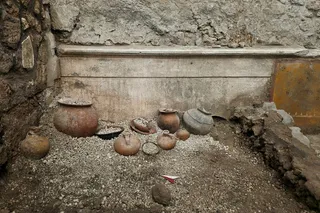
The subterranean chamber carved directly into the bedrock also behaved differently. Almost no seismic amplification was found there, likely because the chamber remains tightly connected to the limestone foundation underneath the pyramid.
The Pyramid’s Shape May Also Help It Resist Earthquakes
Much of the pyramid’s mass sits close to the ground, creating a low center of gravity that helps resist tipping and uneven stress.
It is impossible to know whether the Great Pyramid was deliberately designed to withstand earthquakes. The structure was built more than 4,500 years ago, before anyone understood seismic waves or resonance.
But some of the pyramid’s oldest architectural features may still be helping protect it today. The same chambers built above the King’s Chamber to support thousands of tons of stone may also be softening earthquake vibrations moving through the structure.
Read More: Three Generations Built the Pyramids of Giza Over Time, But How Is Debated
Article Sources
Our writers at Discovermagazine.com use peer-reviewed studies and high-quality sources for our articles, and our editors review for scientific accuracy and editorial standards. Review the sources used below for this article:
- This article references information from a study published in Scientific Reports: Architectural and geotechnical aspects affecting earthquake resilience for the antique Egyptian Khufu pyramid