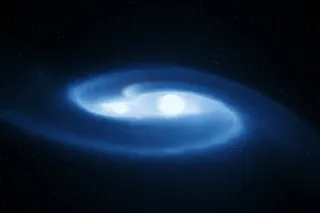
The Milky Way once absorbed a dwarf galaxy, scattering its stars across our own. Billions of years later, some of those stars are still moving through the Milky Way on long, narrow paths that helped astronomers trace the ancient collision.
Astronomers first described this wreckage in 2018, using data from the European Space Agency’s Gaia mission. When they plotted the stars’ motions, the structure took on a sausage-like shape and became known as the Gaia Sausage.
According to a 2018 study published in Monthly Notices of the Royal Astronomical Society, the dwarf galaxy merged with the Milky Way between about 8 billion and 11 billion years ago, around the time the galactic disk was forming. The galaxy had a total mass more than 10 billion times that of the sun.
“The collision ripped the dwarf to shreds, leaving its stars moving in very radial orbits that are long and narrow like needles,” said Vasily Belokurov of the University of Cambridge in a press release. “The stars’ paths take them very close to the center of our galaxy. This is a telltale sign that the dwarf galaxy came in on a really eccentric orbit, and its fate was sealed.”

 Explore All Options
Gaia Sausage Stars Reveal an Ancient Milky Way Collision
The Gaia Sausage was identified by tracking how stars move through the Milky Way. Many stars in the galaxy’s disk orbit the galactic center in a more orderly rotation. The Sausage stars stood out because they moved in highly radial orbits.
These stars fall toward the center of the Milky Way, pass close to it, and then move far back out again. According to the 2018 Monthly Notices of the Royal Astronomical Society study, that motion pointed to debris from one larger satellite galaxy, not the gradual buildup of many smaller ones.
The Milky Way has absorbed smaller galaxies throughout its history, including the Sagittarius dwarf galaxy, which is still being pulled apart today. But the Gaia Sausage collision scattered debris through the inner Milky Way and likely disturbed the young galaxy’s disk.
How the Gaia Sausage Got Its Name
The Gaia Sausage does not describe a visible sausage-shaped object in space. The name comes from a graph of stellar velocities.
“We plotted the velocities of the stars, and the sausage shape just jumped out at us,” explained Wyn Evans of Cambridge in the press release.
A separate 2018 study published in The Astrophysical Journal Letters helped explain how those stars shaped the Milky Way’s halo. The study found that a metal-rich group of halo stars followed stretched-out paths and reached the farthest points in their orbits at about the same distance from the galactic center.
That shared turnaround point lines up with the Milky Way’s stellar halo break, where the number of halo stars drops.
The Gaia Sausage May Have Changed the Milky Way Disk
A 2026 study published in Monthly Notices of the Royal Astronomical Society looked at how the Gaia Sausage collision may have changed the Milky Way’s early disk. Using simulations of galaxies similar to ours, the researchers found that the crash may have erased evidence of an earlier rotating disk.
That could change how astronomers read the Milky Way’s early history. The point at which stars began moving together in a clear disk may not mark when the disk first formed, but rather when the galaxy recovered after the Gaia-Sausage-Enceladus merger.
The study estimates that the collision began about 11 billion years ago and ended around 10 billion years ago. For the first time, the researchers also linked the dwarf galaxy’s first close pass with a burst of star formation and the creation of globular clusters, which are dense groups of old stars.
The dwarf galaxy no longer exists as it once did, but its stars remain in the Milky Way, carrying evidence of a crash that happened before the sun formed.
Read More: A Bright Blob Emitting X-Rays Near the Center of the Milky Way May Have Been Forged by a Supernova
Article Sources
Our writers at Discovermagazine.com use peer-reviewed studies and high-quality sources for our articles, and our editors review for scientific accuracy and editorial standards. Review the sources used below for this article:
- This article references information from a study published in Monthly Notices of the Royal Astronomical Society: Co-formation of the disc and the stellar halo
- This article references information from a study published in The Astrophysical Journal Letters: Apocenter Pile-up: Origin of the Stellar Halo Density Break
- This article references information from a study published in Monthly Notices of the Royal Astronomical Society: Build-up and survival of the disc: from numerical models of galaxy formation to the Milky Way