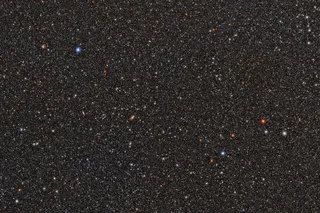


A bright blob of X-ray emission near the heart of the Milky Way may be made of scraps from an exploding star. Astronomers spotted the blob with data from NASA’s Chandra X-ray Observatory, and after taking a closer look, they think it could be a supernova remnant.
A study recently published in The Astrophysical Journal detailed intense X-ray emission in the Sagittarius C star complex, where an expanding bubble of gas might shed light on this environment’s explosive past. The blob buried within this cloud might be the wreckage from a supernova that would have detonated at least 1,700 years ago — and if it truly is a supernova remnant, then it would be one of the closest ever discovered in the central region of the Milky Way, home to the galaxy’s most productive and active star-forming regions.
A Bright Blob Near the Milky Way's Heart
Data from Chandra allowed astronomers to take a closer look at Sagittarius C, a 50-light-year-wide portion of the central molecular zone (CMZ). The CMZ, according to a study presented at the Protostars and Planets VII conference in 2023, is the most extreme star-forming environment in the galaxy, characterized by high densities, temperatures, pressures, turbulent motions, and strong magnetic fields.

 Explore All Options
Dust between Earth and the CMZ obscures visible light, but astronomers have been able to successfully break through this barrier with observations relying on infrared, radio, and some X-ray emissions, according to the Harvard-Smithsonian Center for Astrophysics.
The recent observation of Sagittarius C is just one of these success stories, taking X-ray data from Chandra and the European Space Agency’s XMM-Newton mission, along with radio data from the MeerKAT telescope in South Africa. With this data, astronomers visualized the blob of X-ray emission, which is located about 26,000 light-years from Earth.
Remnants of a Supernova
The blob at Sagittarius C is embedded within a bubble, or shell, of gas that was previously noticed from observations by NASA’s now-retired Stratospheric Observatory for Infrared Astronomy. This bubble contains ionized hydrogen, meaning hydrogen atoms that have been stripped of their electrons by intense ultraviolet radiation from young stars — bright, dense clouds of ionized gas like this one are called H II regions.
The brightness of the blob and the presence of the expanding shell indicate that it might have been left behind by a core-collapse supernova, which is when a massive star collapses in on itself at the end of its life. If it really is a supernova remnant, then it is expanding at about two million miles per hour and is at least 1,700 years old, according to a statement on the study.
The H II region and the blob may share a common origin; the researchers involved with the study suggest that the blob could represent material outflowing from the H II region, but one shortcoming with this interpretation is that the blob is much brighter by comparison.
Searching for Synthesized Elements
When a massive star collapses into a supernova, a wide array of elements is synthesized. These synthesized elements are thrown into interstellar space, and millions or billions of years later, the debris may start to coalesce to form new stars, according to Las Cumbres Observatory.
The research team that found the blob at Sagittarius C, therefore, tried searching for key elements that would have been produced by a supernova. While they didn't find significant enhancement of elements in the blob, they propose that the debris may have already mixed with the surrounding gas.
The researchers bring up alternative explanations for the blob, but ultimately refute them — one is that strong winds may have impacted the shell surrounding the H II region, but this scenario doesn't match the X-ray temperature in the hot gas. They also write that while it could be related to a collection of massive stars in the region, this explanation is unlikely because the blob is more than 10 times brighter than the X-ray emission of large, known clusters of massive stars.
Read More: Potential Ice on the Moon Is Good News for Lunar Exploration or Habitation
Article Sources
Our writers at Discovermagazine.com use peer-reviewed studies and high-quality sources for our articles, and our editors review for scientific accuracy and editorial standards. Review the sources used below for this article:
- This article references information from a study published in The Astrophysical Journal: Diffuse X-Ray Emission in the Sagittarius C Complex
- This article references information from Physics Arxiv: Star Formation in the Central Molecular Zone of the Milky Way
- This article references information from the Harvard-Smithsonian Center for Astrophysics: The Central Region of the Milky Way
- This article references information from the Las Cumbres Observatory: Supernova explosions