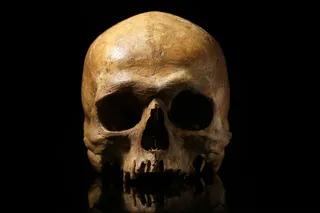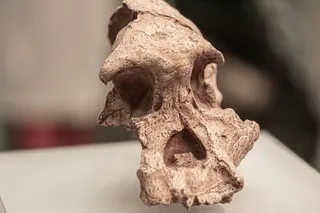


When Omo I lived, more than 230,000 years ago, her skull already displayed features characteristic of Homo sapiens, including a high, rounded cranial vault and a chin. But her body may still have been very different from the one we associate with our species, according to a 2022 Nature study.
Discovered in Ethiopia’s East African Rift Valley in 1967, her skeleton became a key piece of evidence for reconstructing the anatomical origins of modern humans. For decades, measurements of her skeletal remains led researchers to picture her as a relatively tall, slender woman.
Now, a new analysis published in the Journal of the Royal Anthropological Institute challenges that picture: Omo I may have been shorter and stockier than previously thought.
The Body Types of Omo I and Ancient Humans
Osbjorn Pearson, an anthropologist at the University of New Mexico, and John Fleagle, a primatologist at Stony Brook University, reexamined measurements of numerous bones from her skeleton and compared them with those of more recent humans. The researchers identified problems with one of the measurements used to estimate her height, prompting a reassessment of her body proportions.
If the new interpretation is correct, Omo I would have stood about 5 feet 5 inches tall (1.65 meters) and weighed about 157 pounds (71 kilograms), a robust build for her height. The length of her clavicles and the size of her pelvis also suggest a more robust build than previously assumed.

 Explore All Options
This body type contrasts with that of other ancient humans, such as those from Skhul and Qafzeh, who lived around 100,000 years later and tended to be taller and more slender. The researchers suggest that a substantial reduction in body mass relative to height may have occurred during this period, although more fossils are needed to test that hypothesis.
The finding raises a question that goes beyond the stature of a woman who lived hundreds of thousands of years ago: Did the traits we now consider characteristic of Homo sapiens emerge all at once, or did our species acquire its modern anatomy gradually?
“This would add to a growing body of data that refutes the hypothesis that all of the ‘anatomically modern’ traits emerged as a package. They seemed to have evolved gradually and perhaps in a mosaic fashion,” Pearson explained.
Read More: Hominins Moved Into the Neighborhood of the Hobbit Humans Around 1.04 Million Years Ago
Rethinking Omo I
The problem emerged when researchers tried to estimate Omo I’s stature. In a study published in 2008, Pearson and his colleagues obtained two very different estimates: between 5 feet 4 inches and 5 feet 8 inches (1.62 and 1.73 meters) based on a foot bone, and between 5 feet 10 inches and 6 feet (1.78 and 1.82 meters) based on the left humerus, the bone that extends from the shoulder to the elbow.
The discrepancy caught the researchers’ attention again years later. Why did measurements from different parts of the skeleton produce such different stature estimates?
Pearson suspected that some measurements might be unreliable. Some dimensions had to be estimated from incomplete fragments, and wear on the fossil may have affected certain measurements.
“I also worried that abrasion of the original skeleton had made some of the measurements unreliable,” Pearson explained.
When they compared the measurements, the researchers found no clear size difference between the upper and lower body parts. Instead, some uncertain measurements — either estimates or measurements affected by abrasion — seemed to explain the discrepancy.
The authors concluded that the humerus length estimate should be excluded from the analysis. If that measurement is unreliable, Omo I may have stood around 5 feet 5 inches tall. Her body mass, estimated at about 157 pounds, would therefore have been relatively high for her height.
“The new result means that Omo I would have been substantially heavier for her height than we thought. This would make her more like Neanderthals and other Middle Pleistocene humans from Eurasia, for example the people from Sima de los Huesos in Spain or the partial skeleton of a female Denisovan from Jinniushan in northeastern China,” Pearson said.
The length of her clavicles and the size of her pelvis are consistent with that interpretation. Rather than having the tall, slender figure previously proposed for Omo I, she would have had a more robust build, although this reconstruction depends on the lower estimate of her stature being correct.
A Mosaic of Human Traits
The authors compare Omo I with other ancient humans and note that individuals from Skhul and Qafzeh, who lived around 100,000 years later, tended to be tall and slender. Moreover, the relatively high body mass now estimated for Omo I does not appear to have persisted in more recent African populations: humans from the Late Pleistocene and Holocene tended, instead, to have relatively low body mass for their height.
The comparison raises the possibility that early modern human body proportions changed over time. However, the available fossils do not yet establish whether this represented a widespread evolutionary shift or whether Omo I was at the stockier end of an anatomically diverse population.
“Exactly how ‘anatomically modern’ the earliest anatomically modern humans were has been a subject of debate since the 1930s,” Pearson noted.
He added: “It is quite possible that the features characteristic of modern humans evolved at different times and that there was also a substantial amount of anatomical variation between individuals in those ancient populations.”
The extent and causes of that variation remain unclear.
But what factors might have led our ancestors to have more robust or compact bodies before evolving toward more slender proportions?
“We only have hypotheses for why this might have been,” the anthropologist cautions. One possibility is climate. Individuals in cold environments may have been stockier. It has also been proposed that hunting among archaic humans involved more sprinting and forceful movements and actions close to their prey, whereas around 100,000 years later, humans may have begun killing prey from greater distances.
Another hypothesis holds that Neandertals and other archaic humans relied heavily on hunting large and very large herbivores for subsistence, whereas modern humans consumed a more varied diet that included smaller prey alongside some large animals.
“None of these hypotheses explain all the data we have from the fossil and archaeological records, so I think the question of ‘why’ remains open,” Pearson concluded.
Read More: What a 1.5-Million-Year-Old Face Reveals About Early Human Migration
Article Sources
Our writers at Discovermagazine.com use peer-reviewed studies and high-quality sources for our articles, and our editors review for scientific accuracy and editorial standards. Review the sources used below for this article:
- This article references information from a study published in Nature: Age of the oldest known Homo sapiens from eastern Africa
- This article references information from a study published in the Journal of the Royal Anthropological Institute: A closer look at the postcranial skeleton of Omo I from the Kibish Formation, Ethiopia: points of divergence from recent humans