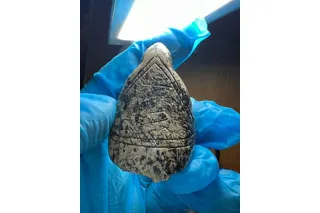
In the 1960s, an excavation in the Judean Desert in Palestine turned up a small copper-alloy ring engraved with Greek letters. The ring, thought to be about 2,000 years old, sat in storage for another 50 years. Now, a re-analysis published in the journal Palestine Exploration Quarterly suggests the jewelry may have an ancient link to Pontius Pilate, the Roman governor of Judea recorded in the New Testament as having ordered the crucifixion of Jesus.
The ring was first reassessed in 2018, when a debate began over what the Greek inscription and the image of a stoneware vessel that adorns the ring might mean. At the time, scholars thought the symbols, reading ΠΙΛΑΤΟ in Ancient Greek, indicated that an individual called Pilate (but not the governor himself) or someone in the Judean administration may have owned the ring. Other researchers argued that the ring was not connected to Pilate at all.
The new article takes a different perspective. Catherine Bonesho, a scholar of ancient Judaism at the University of California, Los Angeles, has deduced that the ring’s lettering likely translates from the Latin word pilato, meaning “for Pilate.” The ring’s owner was likely not the governor, but possibly a Judean slave who worked in his administration. The ring may have been used as a stamp to mark out Pilate’s name in deliveries.

 Explore All Options
Lost in Mistranslation
Bonesho began studying the ring after seeing a Facebook post that mentioned its unusual spelling. She realized that if the ring really was marked with words signifying ownership by Pilate, its Greek letters should read ΠΙΛΑΤΟY, rather than ΠΙΛΑΤΟ. While some academics theorized that the altered spelling resulted from a missing upsilon (Y) at the end of the word, Bonesho proposed an alternative.
The ring might instead have been meant to read ΠΙΛΑΤΩ, a rough rendering of pilato. The fact that the engraving’s last letter is an “O” rather than the correct Greek letter omega (Ω) suggests that the writer may not have had a solid grasp of Latin. This cemented her position that the owner was likely a Judean slave living in a region that the Romans had colonized for under a century.
“The mixing up of omicron and omega for long and short ‘o’ vowels in transliterating Latin into Greek is common among early Latin language learners,” Bonesho said in a statement.
What the Ring Says About Ancient Social Structure
Analysis of the ring’s materials held further hints. At the time, members of the upper Roman classes were less likely to wear copper alloy, preferring gold or jeweled rings. Instead, local Judeans or low-ranking soldiers likely wore it. Finally, the vessel cut into the ring is a common Judean symbol from the time.
Bonesho said that, beyond the ring’s Biblical connection, the item reveals valuable information about the social structure of ancient Judea. Rather than a strict hierarchy in which only Romans were allowed to work in the colonial administration, the ring suggests that, at least at some levels, local Judeans were bound into work.
“Complexity often gets lost in popular narratives of how things worked at that time,” she said. “But understanding the ring gives us more insight into what the Roman administration of early Roman Judea looked like, in terms of how authority was distributed into the lower echelons of the political structure.”
Read More: Ancient People Wore Jewelry for its Protective Power, and Other Mystical Purposes
Article Sources
Our writers at Discovermagazine.com use peer-reviewed studies and high-quality sources for our articles, and our editors review for scientific accuracy and editorial standards. Review the sources used below for this article:
- This article references information from Palestine Exploration Quarterly: The Pilate Ring: A Reconsideration