When faced with an immediate threat, many animals have a fairly predictable response: they either fight, flee, or freeze. Lizards went a different way. At some point in their evolutionary history, they instead developed autotomy — the ability to voluntarily shed an entire tail, leaving the predator distracted by a smaller snack while the lizard makes an escape.
The lizard species that can deploy this tactic are far from alone — some 200 or more species of invertebrates, plus many reptiles, fish, and even a couple of mammal species are also able to sacrifice and then regenerate bits of their body as a last-ditch escape mechanism. But lizards are probably the most iconic, and now, in a surprise find worthy of a blockbuster movie, we have evidence of that same ability in their ancient relatives.
“I nearly jumped out of my chair,” said Leonidas-Romanos Davranoglou, a researcher at Tel Aviv University’s School of Zoology and Steinhardt Museum of Natural History and lead author of a study detailing the find, in a press release.
The reason? A tiny defect in an ancient piece of amber, long assumed to be a tiny piece of wood or an insect fragment, that his Ph.D. candidate, Dolev Fabrikant, had deduced was something entirely different.

 Explore All Options
“I realized that what seemed to be a twig was covered in tiny scales,” Fabrikant explained in the press release. “It was a lizard’s tail.”
Read More: These Amber Fossils Offer a “Snapshot of Life on Earth Millions of Years Ago”
Earliest Evidence For An Iconic Trait

(Image Credit: Dolev Fabrikant/CCBY)
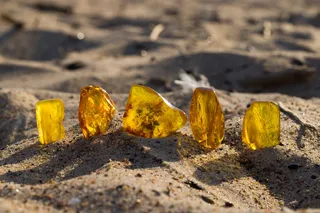
It might seem strange that such an important fossil went unnoticed for so long, but circumstances worked against its discovery. The tail is just 0.7 inches long — that’s 18 millimeters, or barely longer than an aspirin tablet — and encased in cloudy, microscopic amber. Even under a microscope, the fossil couldn’t reveal much about the specimen.
Instead, the researchers had to turn to something a little more high-tech: micro-computed tomography scans, or micro-CT.
“Micro-CT takes X-ray images from many angles and combines them into a three-dimensional reconstruction,” explained Ahmed Nasser, Head of the institute’s Inter-Institutional Analytical Unit and coauthor of the new work, in the press release. “It allowed us to examine structures hidden by the amber without needing to cut this one-of-a-kind piece open.”
The scans revealed something incredible: a tail, for sure, but one recognizably similar to those of modern lizards. It had left its owner’s body cleanly, with no signs of being removed through accident or injury; it was symmetrical, and overall clearly resembled the dropped tails of lizards alive today.
In other words, the pair had somehow stumbled upon the earliest evidence of a voluntarily dropped lizard tail.
“I instantly realized that this tiny fossil could open an extraordinary window into the past, helping us understand the history of one of the most widespread survival strategies among reptiles,” explained Davranoglou.
“Until now, we could only speculate on whether ancient lizards could shed their tails,” he said. “We now have direct evidence that one could.”
What We Know About the Lizard and What We’ll Never Know
At around 99 million years old, the discovery provides proof that lizards were dropping their tails at least as far back as the Cretaceous Period. Given what we know about lizard genetics, it also strongly suggests that those ancient reptiles may have already developed the ability to regrow the missing appendages after they escaped. It’s undoubtedly an important, information-rich find.
But it’s also tantalizingly incomplete. Why was the tail shed? Was it stuck in resin before, or after it was dropped? Did the lizard survive? These are questions we’ll likely never see answers to.
In fact, we don’t even know what kind of lizard unknowingly provided this specimen so long ago.
“Although we can securely identify this specimen as a lizard, we lack the skull and other skeletal features that would allow a more secure identification,” explained Apostolos Christopoulos, a Ph.D. candidate at the National and Kapodistrian University of Athens and coauthor on the study in the press release.
Their best guesses? Based on the details of the few scales they could make out, it might have been a member of either the group containing modern lizards like whiptails and wall lizards, or else the one containing today’s slow worms and monitor lizards. Even this, however, is tentative — and the team hopes that a complete fossil may soon be found to complete this part of the story.
Read More: Deep-Sea Deposits of Amber May Document Massive 116-Million-Year-Old Tsunamis
Article Sources
Our writers at Discovermagazine.com use peer-reviewed studies and high-quality sources for our articles, and our editors review for scientific accuracy and editorial standards. Review the sources used below for this article:
- This article references information from a study published in Palaeontologia Electronica: First Fossil Evidence for a Dropped Lizard Tail
- This article references information from a study published in the Journal of Zoology: To cut a long tail short: a review of lizard caudal autotomy studies carried out over the last 20 years